
Retrieval-Augmented Generation, or RAG, has become one of the standard ways to connect an LLM with external knowledge. But traditional RAG usually follows a fairly predictable path: receive a question, search a knowledge base, retrieve some relevant chunks, and give them to the language model.
That approach works well for straightforward questions.
But what happens when a question requires several searches, information from different sources, or a second search based on what the first search discovered?
That’s where Agentic RAG comes in.
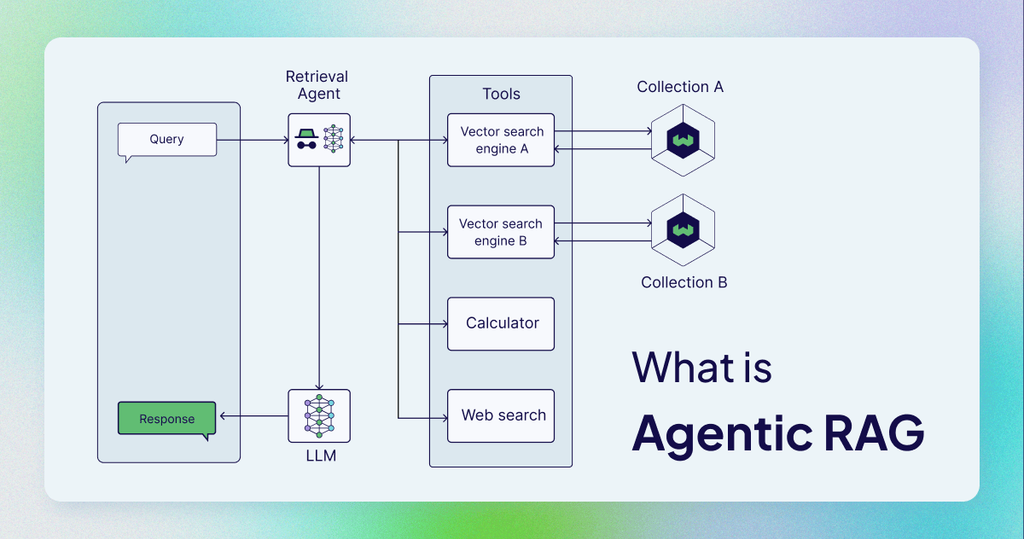
Instead of treating retrieval as one fixed step, Agentic RAG gives an AI agent control over the retrieval process. The agent can decide what to search, when to search, which retrieval tool to use, whether the results are sufficient, and whether another retrieval step is necessary. AWS describes this as retrieval becoming a dynamic reasoning action rather than a static part of the pipeline. AWS Documentation
In simple terms:
Traditional RAG retrieves information for the model. Agentic RAG lets the model actively manage the retrieval process.
What Is Agentic RAG?
Agentic RAG is a retrieval-augmented generation architecture in which an AI agent can plan, execute, evaluate, and repeat retrieval actions before generating its final answer.
A traditional RAG system might look like this:
Question → Search → Retrieve → LLM → Answer
An Agentic RAG system can look more like:
Question → Plan → Search → Evaluate → Search Again → Combine Evidence → Verify → Answer
The important difference isn’t simply adding an “agent” label to RAG.
The real difference is control.
In a conventional pipeline, developers generally decide ahead of time which search method runs and how many results are retrieved. In Agentic RAG, the agent can dynamically decide which retrieval actions are necessary. Microsoft describes this distinction as an agent treating retrieval as a tool that it can invoke on demand. Microsoft Learn
Traditional RAG vs Agentic RAG
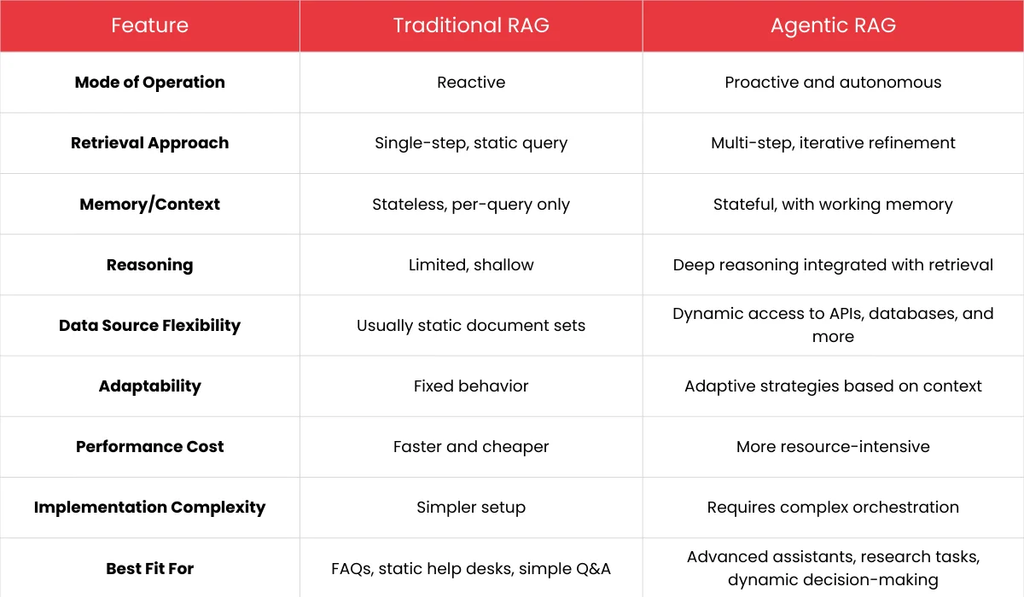
Here’s the easiest way to understand the difference.
| Feature | Traditional RAG | Agentic RAG |
|---|---|---|
| Retrieval | Usually fixed | Dynamic |
| Query processing | Usually predefined | Agent can plan |
| Number of searches | Often predetermined | Can perform multiple searches |
| Query decomposition | Usually application logic | Agent can decide |
| Tool selection | Preconfigured | Agent can select |
| Result evaluation | Limited or predefined | Agent can evaluate |
| Multi-step research | More difficult | Natural fit |
| Complexity | Lower | Higher |
| Latency | Usually predictable | Can vary |
| Cost | Easier to estimate | Potentially higher |
| Best for | Straightforward knowledge retrieval | Complex, multi-step tasks |
This doesn’t mean Agentic RAG replaces traditional RAG.
For a simple FAQ such as:
“What is the refund period?”
a fixed retrieval pipeline may be all you need.
But consider:
“Compare the refund policies for our three products, check whether the policies changed recently, and explain which customers are affected.”
Now the system may need several retrieval operations.
That’s where an agent-controlled workflow becomes more useful.
How Does Agentic RAG Work?
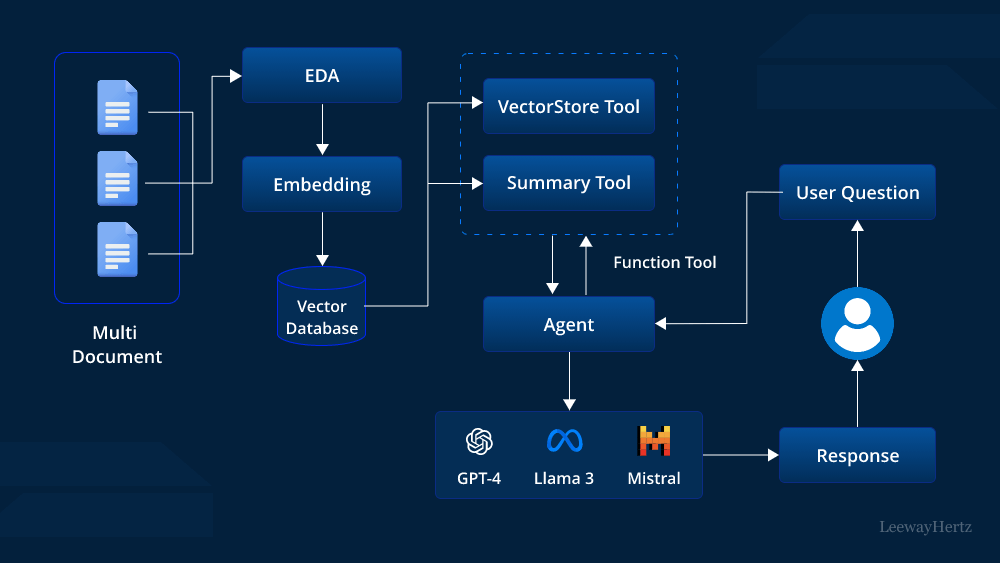
A typical Agentic RAG architecture contains several stages.
1. Understand the user’s question
The agent first determines what the user is actually asking.
It may identify:
- The main objective
- Required information
- Relevant sources
- Whether the question contains multiple sub-questions
- Whether external tools are required
2. Create a retrieval plan
The agent can break a complex question into smaller information needs.
For example:
“How did Company X’s revenue change between 2023 and 2025, and what were the major reasons?”
The agent might decide to retrieve:
- 2023 financial information
- 2024 financial information
- 2025 financial information
- Management commentary explaining changes
3. Execute retrieval
The agent then calls one or more retrieval tools.
Those tools might include:
- Vector search
- BM25
- SQL
- Graph databases
- Internal APIs
- Web search
- Document search
- Enterprise knowledge bases
4. Evaluate the results
This is one of the biggest differences from traditional RAG.
The agent can ask:
“Do I have enough evidence to answer the question?”
If the answer is no, it can search again.
5. Refine the search
The next query can be based on information discovered during the previous retrieval step.
For example:
Initial search:
“Company X revenue 2025”
New information discovered:
Revenue declined because of a specific business segment.
Follow-up search:
“Company X segment revenue decline 2025 explanation”
This creates an iterative retrieval loop.
6. Assemble the evidence
Once sufficient information has been collected, the agent can organize the retrieved evidence and provide it to the generation model.
7. Generate the answer
Finally, the LLM synthesizes the evidence into an answer, ideally with citations or source references.
The Agentic RAG Workflow
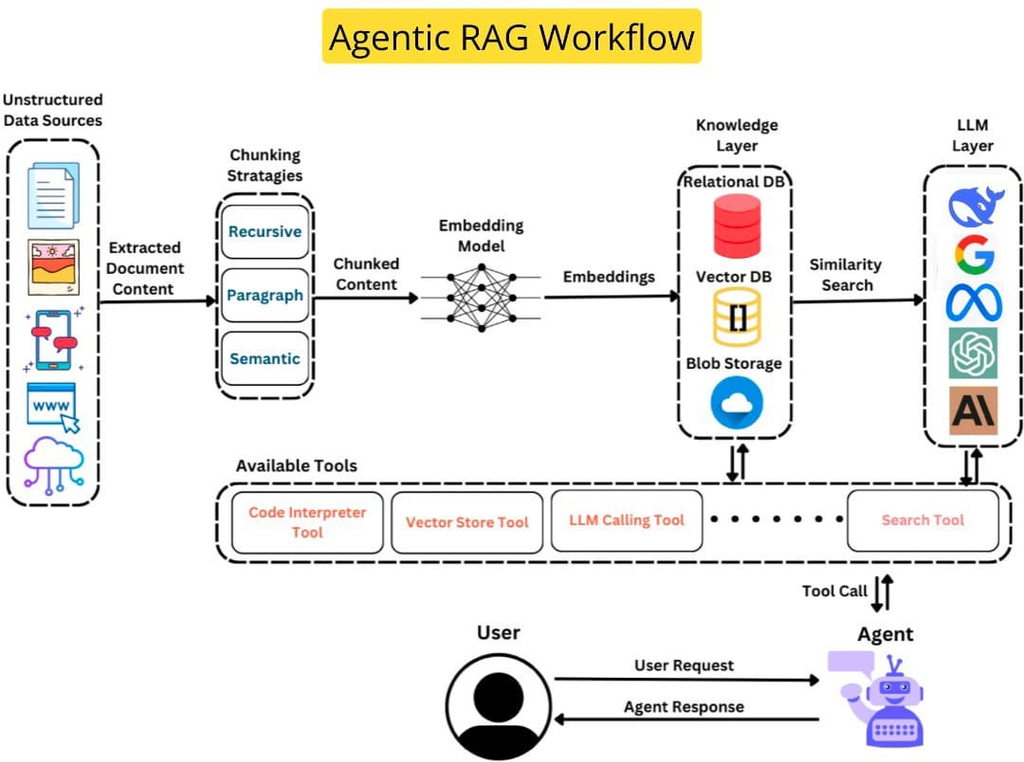
A simplified architecture looks like this:
User Question
      ↓
   AI Agent
      ↓
  Understand Task
      ↓
  Create Plan
      ↓
 ┌───────────────┐
 │ Retrieval Tool│
 └───────┬───────┘
         ↓
    Search Results
         ↓
   Evaluate Results
         ↓
   Enough Evidence?
      ↙       ↘
    No         Yes
    ↓           ↓
Search Again   Synthesize
    ↓           ↓
    └──────→  LLM Answer
                 ↓
             Citations
This loop is the heart of Agentic RAG.
Why Traditional RAG Can Struggle With Complex Questions
Traditional RAG isn’t bad. In fact, it’s often the right starting point.
The problem appears when the question doesn’t map neatly to one retrieval operation.
For example:
“Which product had the highest growth, why did it grow, and which customer segment contributed most to that growth?”
A single similarity search might retrieve documents containing “growth,” but it doesn’t necessarily understand that the question requires several related pieces of evidence.
An agent can instead decompose the task.
It could search for:
- Product growth
- Product-level performance
- Customer segmentation
- Growth drivers
- Supporting financial data
This is why recent research increasingly describes Agentic RAG as a system involving planning, iterative retrieval, memory, and tool use rather than simply a larger RAG pipeline. arXiv
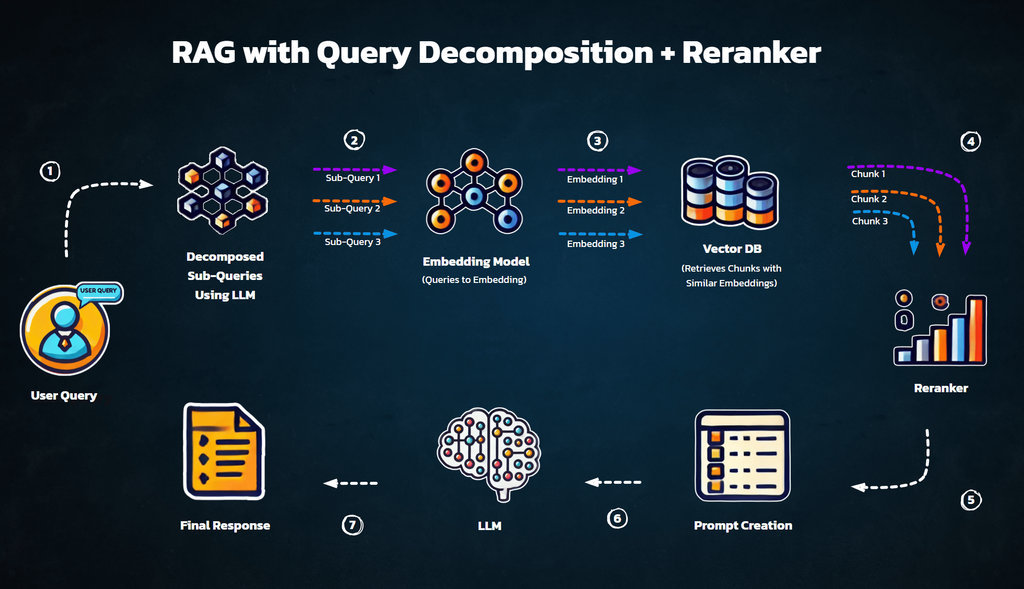
Agentic RAG and Query Decomposition
Query decomposition is particularly useful for complicated questions.
Suppose someone asks:
“Compare the security features of Product A and Product B, identify their authentication methods, and explain which features are available in the enterprise plan.”
Instead of searching the entire question once, the agent could create smaller queries:
1. Product A security features
2. Product B security features
3. Product A authentication methods
4. Product B authentication methods
5. Product A enterprise plan
6. Product B enterprise plan
The results can then be combined.
This approach can be especially useful when relevant information is distributed across different documents.
Agentic RAG Can Use Multiple Retrieval Tools
Another advantage is that retrieval doesn’t have to mean “vector database.”
An agent can potentially choose between different tools depending on the task.
For example:
| Question | Possible Tool |
|---|---|
| Find semantically similar documents | Vector search |
| Find exact product code | BM25 |
| Calculate revenue | SQL |
| Find relationships | Graph database |
| Retrieve latest information | Web/API |
| Search company documentation | Enterprise search |
| Retrieve customer record | Internal API |
This makes Agentic RAG more like an AI research workflow than a simple search pipeline.
Anthropic’s own research system illustrates this broader pattern: an orchestrator can create specialized subagents that search different aspects of a question and then combine their findings. Anthropic
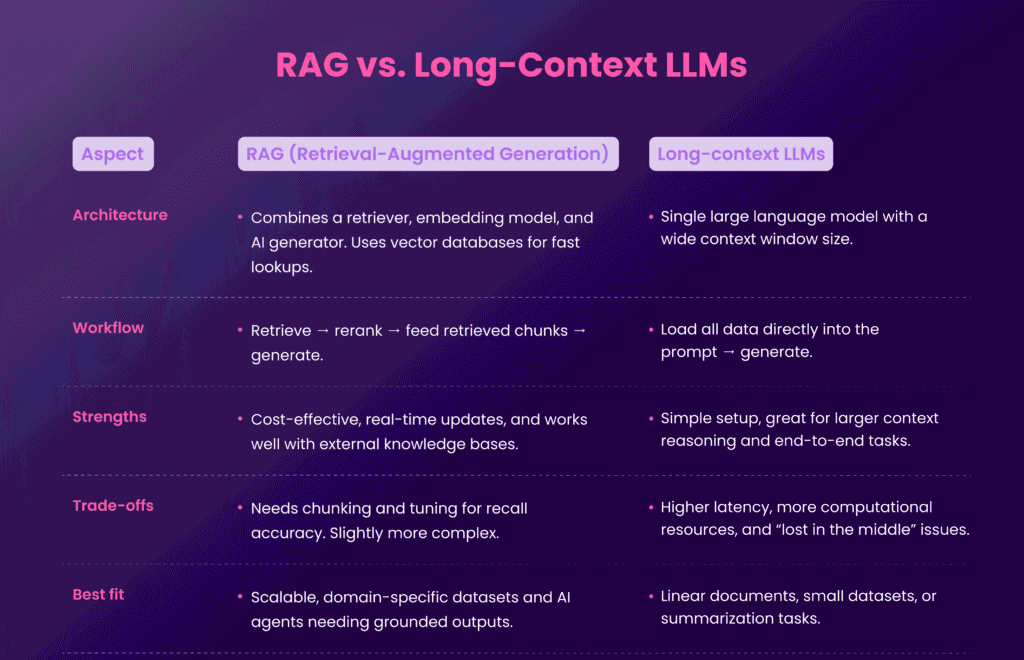
Agentic RAG vs Long Context
There’s an interesting question here:
If modern models can handle extremely large context windows, why use RAG at all?
The answer depends on the workload.
If your knowledge base is small enough, putting all of it into the context can sometimes be simpler than implementing retrieval. Anthropic explicitly notes this for knowledge bases below roughly 200,000 tokens in one of its published discussions.
But larger knowledge bases create different problems.
You may have:
- Millions of documents
- Frequently changing information
- Permission-sensitive information
- Expensive context
- Redundant content
- Multiple data sources
In those cases, dynamically retrieving only the information needed can be more practical.
Agentic RAG takes this idea one step further:
Don’t just retrieve relevant context. Let the agent decide what context it needs.
When Should You Use Agentic RAG?
Agentic RAG is particularly interesting when the task involves multiple steps or uncertain information requirements.
Good use cases include:
Enterprise research
An employee might ask:
“Summarize how our pricing changed over the last three years and explain why.”
The system may need to inspect several documents.
Financial analysis
Questions can require multiple datasets, calculations, and supporting documents.
Customer support
An agent may need to combine product documentation, customer account information, previous tickets, and troubleshooting guides.
Legal research
A question may require finding several related clauses, cases, or documents before producing an answer.
Technical research
Developers may ask questions that require searching documentation, code, issues, changelogs, and API references.
Multi-document analysis
Whenever the answer isn’t contained in a single document, iterative retrieval becomes more useful.
When Should You NOT Use Agentic RAG?
This is just as important.
Don’t add an agent simply because “agentic AI” sounds more advanced.
For a simple application:
Question → Search → Answer
may be perfectly adequate.
Agentic RAG can introduce:
- More latency
- More model calls
- Higher token usage
- More infrastructure
- More complicated debugging
- More failure modes
Recent research has highlighted risks such as compounding errors, retrieval misalignment, memory poisoning, and cascading tool failures in autonomous retrieval loops. arXiv
So the question shouldn’t be:
“Can we make this RAG system agentic?”
Instead ask:
“Does the problem actually require dynamic retrieval and decision-making?”

How to Build an Agentic RAG System
A practical implementation can start relatively simple.
Step 1: Build normal RAG first
Start with:
Documents → chunks → embeddings → retrieval → LLM
Make sure your baseline works.
Step 2: Turn retrieval into a tool
Instead of automatically running retrieval, expose it to the agent as a function.
Conceptually:
search_knowledge_base(query)The agent can now decide when to call it.
Step 3: Add query planning
Give the agent the ability to break complex questions into smaller tasks.
Step 4: Add result evaluation
After retrieval, ask the agent whether the results are sufficient.
Step 5: Allow another retrieval cycle
If the evidence isn’t sufficient, the agent should be able to search again.
Step 6: Add guardrails
Set limits such as:
- Maximum retrieval iterations
- Maximum tool calls
- Maximum tokens
- Allowed data sources
- Timeout limits
- Permission checks
This prevents an agent from entering an expensive retrieval loop.
Step 7: Evaluate the complete trajectory
Don’t only evaluate the final answer.
Also inspect:
Question → Plan → Tool Calls → Retrieved Evidence → Decisions → Final Answer
That’s increasingly important because a final answer can look reasonable even when the underlying retrieval process was inefficient or poorly grounded.
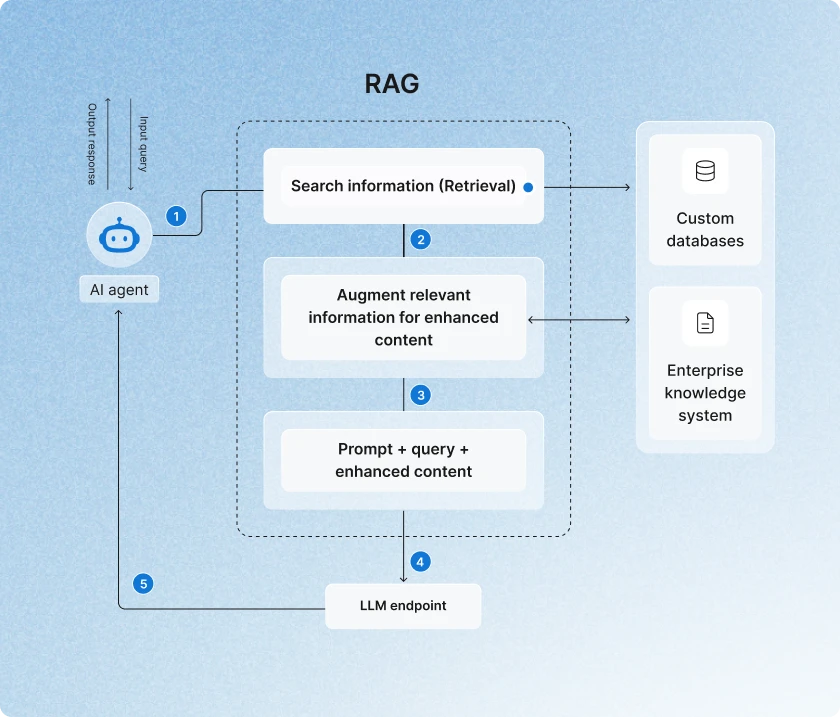
Agentic RAG Best Practices
Start with the simplest architecture
If conventional RAG solves the problem, don’t add an agent.
Keep retrieval tools focused
Give the agent clear tools with predictable inputs and outputs.
Limit retrieval loops
A maximum number of iterations can prevent runaway costs.
Track every tool call
Logging the agent’s retrieval trajectory makes debugging much easier.
Evaluate retrieval separately
Measure whether the agent found the right information before judging the final answer.
Preserve source metadata
Keep document IDs, URLs, sections, timestamps, and permissions with retrieved content.
Use hybrid retrieval when appropriate
Semantic retrieval and lexical search can complement each other. Anthropic’s published Contextual Retrieval work, for example, found benefits from combining embeddings with BM25 and reranking in its experiments. Anthropic
Don’t confuse more retrieval with better retrieval
An agent that makes ten searches isn’t automatically better than one that makes two.
The objective is:
Enough evidence + minimal unnecessary work.
The Future of Agentic RAG
Agentic RAG is moving toward systems where retrieval becomes increasingly dynamic.
Instead of:
“Search this database.”
the architecture becomes:
“Figure out what information you need, decide where to find it, retrieve it, inspect what you found, and continue until you have enough evidence.”
Recent research is exploring this direction through logical retrieval, structured retrieval intents, multi-step planning, and more adaptive retrieval strategies.
At the same time, context engineering is becoming important because agents need to decide not only what to retrieve, but also what information should actually enter the model’s context. Anthropic describes this as a shift toward “just-in-time” context, where agents dynamically load information through tools rather than preprocessing everything into context upfront.
That makes Agentic RAG an important bridge between three areas:
RAG + AI Agents + Context Engineering
Frequently Asked Questions
What is Agentic RAG in simple terms?
Agentic RAG is RAG where an AI agent controls the retrieval process. Instead of performing one predefined search, the agent can decide what to search, evaluate the results, search again, and then generate an answer.
What is the difference between RAG and Agentic RAG?
Traditional RAG usually follows a fixed retrieval pipeline. Agentic RAG allows an AI agent to dynamically control retrieval, including query planning, tool selection, iterative searches, and result evaluation. AWS Documentation
Is Agentic RAG better than traditional RAG?
They solve different problems. Traditional RAG can be simpler and more predictable for straightforward retrieval. Agentic RAG is designed for tasks requiring multi-step reasoning, dynamic retrieval, or multiple information sources.
Does Agentic RAG reduce hallucinations?
It can help when better retrieval and verification provide stronger evidence, but it does not automatically eliminate hallucinations. Agentic loops can also introduce new failure modes, so evaluation and guardrails remain important. arXiv
Is Agentic RAG expensive?
It can be more expensive than traditional RAG because the agent may make multiple model calls and retrieval operations. Cost depends on the model, number of iterations, retrieval infrastructure, context size, and tool usage.
Can Agentic RAG use vector databases?
Yes. A vector database can be one of the retrieval tools available to the agent. The system can also combine vector search with keyword search, SQL, APIs, graph databases, or other information sources.
Is Agentic RAG the same as an AI agent?
Not exactly. An AI agent is a broader concept involving autonomous decision-making and tool use. Agentic RAG is a specific architecture where the agent actively manages retrieval as part of solving a task.
Should I build Agentic RAG for every RAG application?
No. Start with the simplest architecture that satisfies the requirements. Add agentic behavior when the application genuinely benefits from planning, iterative retrieval, multiple tools, or complex multi-document reasoning.
Conclusion
Traditional RAG changed how developers connect LLMs with external knowledge.
Agentic RAG changes who controls the retrieval process.
Instead of forcing every question through the same retrieval pipeline, an agent can decide what information it needs, which tool to use, whether the retrieved evidence is sufficient, and whether another search is necessary.
That makes Agentic RAG particularly interesting for complex research, enterprise knowledge systems, technical support, financial analysis, and multi-document applications.
But there’s an important catch: agentic doesn’t automatically mean better.
The additional flexibility comes with additional cost, latency, complexity, and failure modes.
For simple questions, traditional RAG may remain the better architecture.
For complex questions that require multiple retrieval steps, dynamic planning, and information from different sources, Agentic RAG can provide a much more flexible foundation.
The bigger trend is even more interesting:
RAG is moving from “retrieve once and generate” toward “reason, retrieve, evaluate, retrieve again, and then generate.”
And that shift is bringing RAG much closer to the way modern AI agents actually work.