
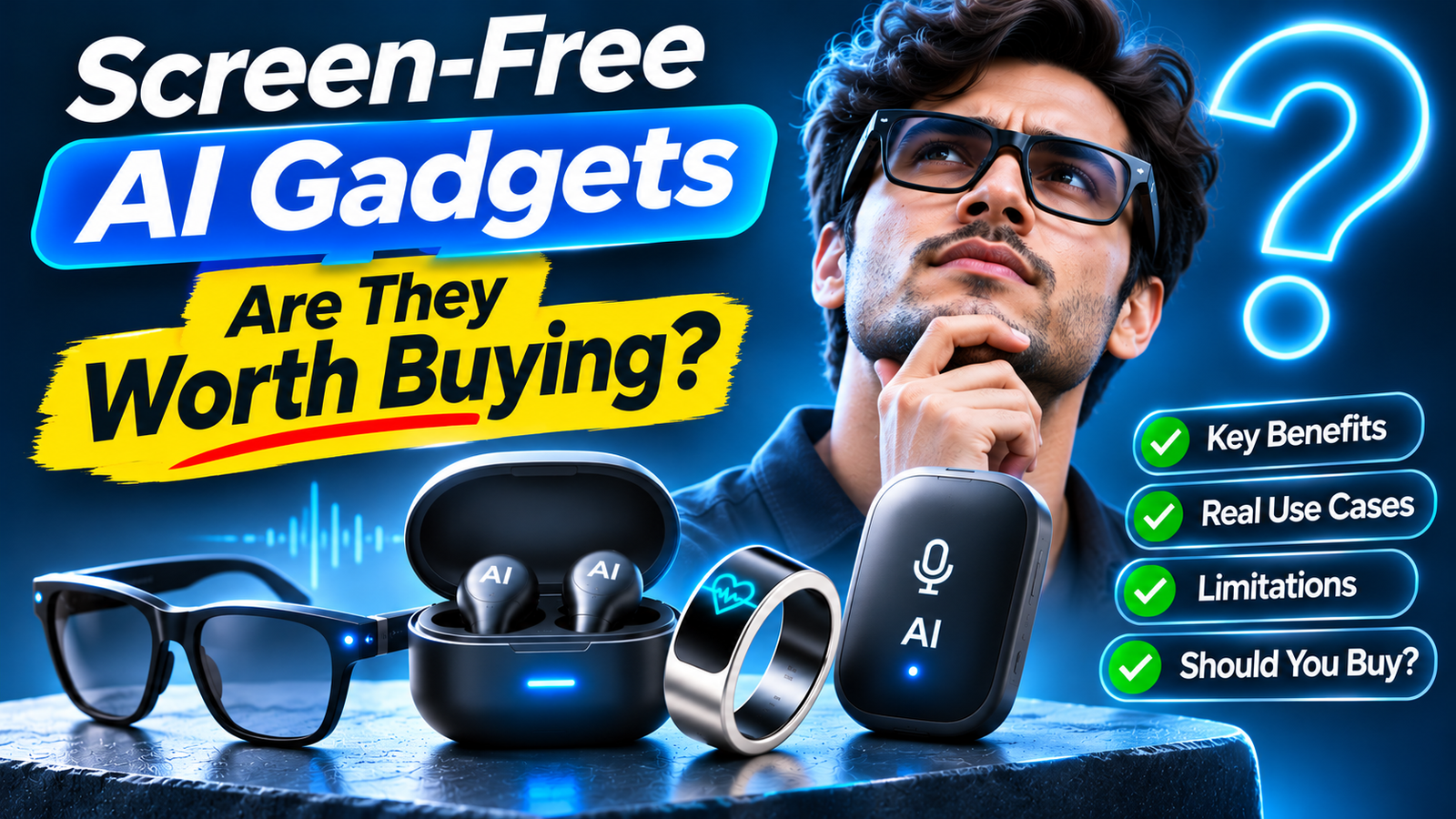
Your next AI assistant might not live inside your smartphone. It could sit on your desk, clip onto your clothes, fit around your finger or work through a pair of earbuds.
That idea is attracting attention in the technology industry. Companies are exploring devices that can capture information, respond to voice commands and help with everyday tasks without asking users to open another app or look at another screen.
One of the latest developments is from Nothing. Its CEO, Carl Pei, has confirmed that the company plans to ship its first AI-native product in December 2026. He says it will have no new screen and cannot simply be replicated as an app. However, the company has not yet revealed its product name, price or exact features.
So, are screen-free AI gadgets the next big thing, or are they another technology trend that sounds more useful than it really is?
Let’s look at what these devices can do, what is changing in 2026, and what buyers should consider before spending money on one.
What Are Screen-Free AI Gadgets?
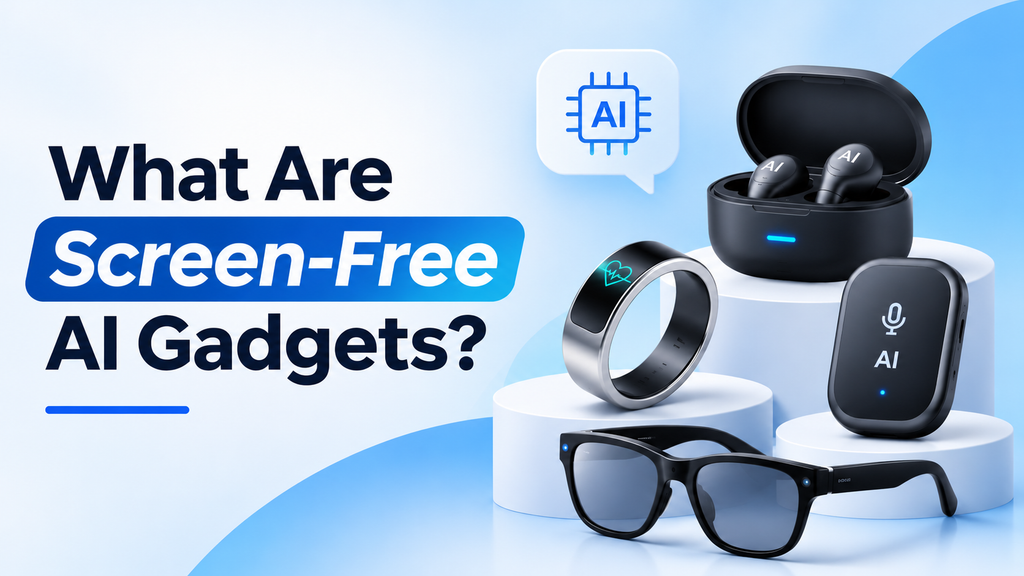
Screen-free AI gadgets are physical devices designed to provide AI-powered features without relying on a traditional built-in display.
Instead of tapping through menus, users may interact with them through voice commands, microphones, buttons, sensors or a connected smartphone.
Depending on the product, these devices may be designed to:
- Record and summarize meetings.
- Capture quick notes and ideas.
- Answer questions through voice.
- Provide reminders and productivity assistance.
- Track selected health or activity information.
- Interact with AI services through a connected phone or computer.
The important distinction is that screen-free does not necessarily mean phone-free or internet-free. Many devices still depend on a smartphone app, cloud processing, a subscription or an internet connection to deliver their main features.
The category includes AI voice recorders, smart rings, selected earbuds, smart glasses and other wearable devices. Not every wearable is an AI gadget, and not every screen-free product has the same capabilities.
Why Are Companies Building AI Gadgets Without Screens?
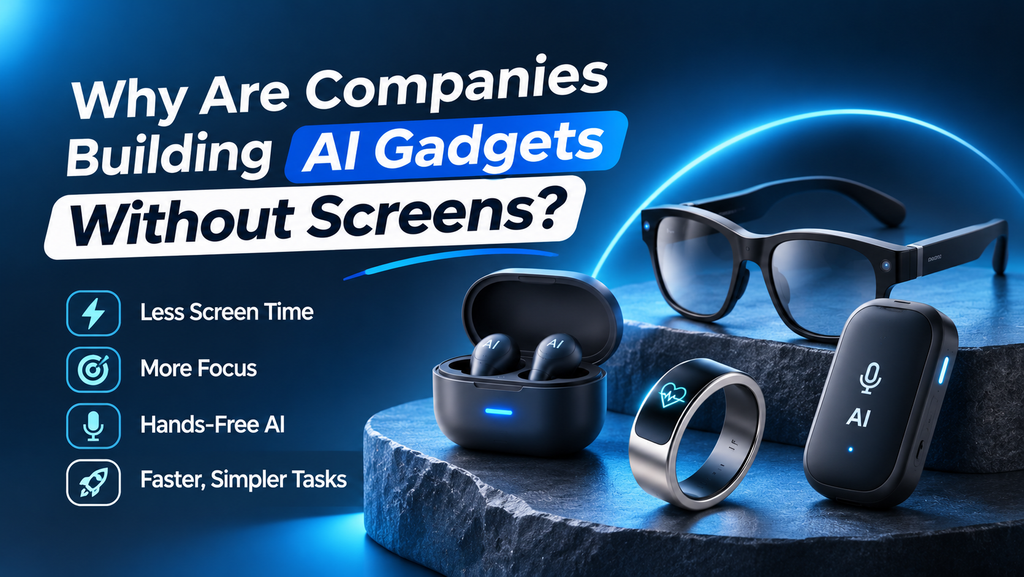
Smartphones are useful, but they also demand attention. Even a simple task—saving an idea, checking a reminder or asking an AI assistant a question—can involve unlocking a phone, opening an app and navigating a screen.
Hardware companies are exploring a different approach: make AI available in situations where reaching for a phone is inconvenient.
Imagine you are attending a meeting. Instead of typing every important point, a recording device could capture the conversation and help create a transcript or summary later.
Or imagine you are walking and remember something important. A voice-enabled device could let you save the idea without opening a notes app.
This is the productivity argument behind many screen-free AI products.
However, convenience alone does not make a gadget valuable. A new device needs to solve a problem better than an existing phone, smartwatch or pair of earbuds. If it creates extra charging, setup and subscription requirements, people may not keep using it.
Nothing’s Upcoming AI Device: What We Know So Far
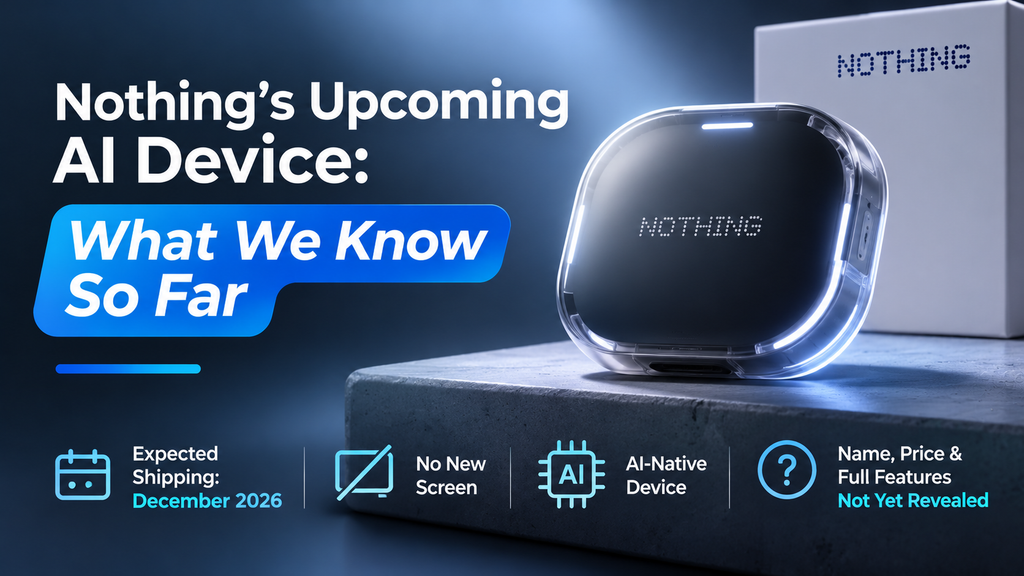
Nothing is one of the latest companies to enter the conversation around dedicated AI hardware.
On November 4, 2026, Nothing CEO Carl Pei announced that the company’s first AI-native product is planned to ship in December. He described it as a tool built around the company’s product design philosophy and said it would have no new screen and could not simply have been an app.
The announcement is interesting because it suggests Nothing wants to explore a new way of interacting with AI rather than adding another feature to a smartphone.
But there are important details that remain unknown.
| Detail | What is confirmed |
|---|---|
| Company | Nothing |
| Product | First AI-native product |
| Expected shipping | December 2026 |
| Display | No new screen, according to Carl Pei |
| Product name | Not announced |
| Price | Not announced |
| Exact features | Not announced |
| Availability by country | Not confirmed |
Nothing has not confirmed whether the device will be a wearable, voice recorder, pendant, smart accessory or another type of product.
It is tempting to guess that it will record conversations or summarize meetings, but those features have not been officially confirmed. Buyers should wait for the full announcement before making decisions.
For the latest confirmed information, follow Nothing’s official website and its announcements.
Types of Screen-Free AI Gadgets You Should Know
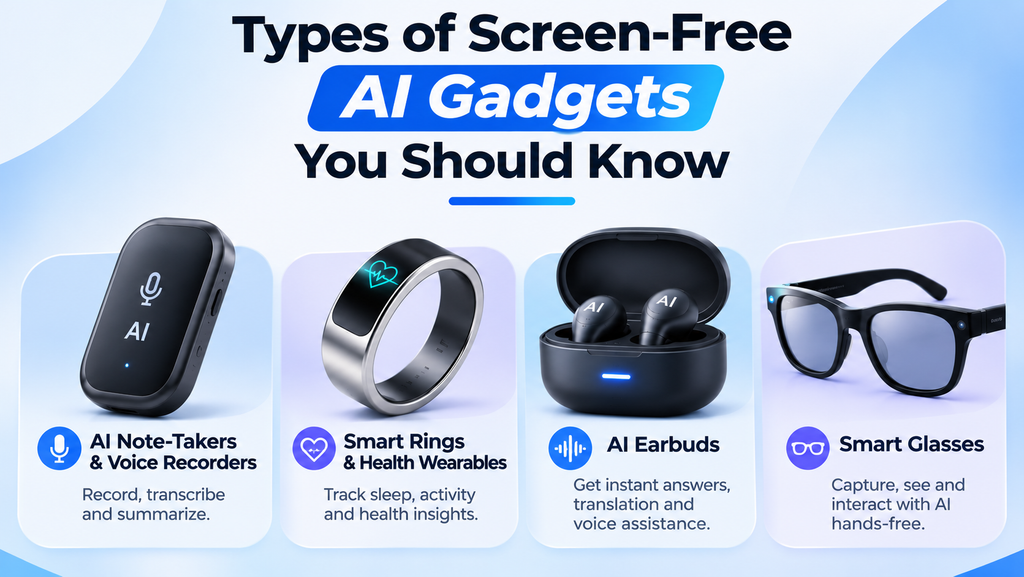
Screen-free AI is not one single product category. Different devices approach the idea in different ways.
1. AI Note-Takers and Voice Recorders
AI note-taking devices are among the clearest examples of screen-free productivity hardware.
They are designed to capture spoken information and use software to turn recordings into searchable transcripts, summaries or action points.
A typical workflow may look like this:
- Start a recording using a button or voice command.
- The device captures the conversation.
- Audio is processed locally or through a connected service.
- The companion app displays a transcript or summary.
- The user reviews and organizes the information.
These devices can be useful for professionals who attend frequent meetings, students who want to review lectures, journalists conducting interviews and people who prefer speaking rather than typing.
For example, the Pebble Qore Vox was reported as a screenless wellness band with voice-recording and AI-summary features. The product illustrates how companies are combining traditional wearable functions with information-capture tools.
Before buying a voice recorder, check its recording quality, supported languages, transcription accuracy, export options, storage limits and subscription costs.
2. Smart Rings and Health Wearables
Smart rings are another growing wearable category. Unlike traditional smartwatches, they usually avoid a large display and focus on collecting selected health and activity measurements.
Depending on the product, features may include:
- Sleep tracking.
- Heart-rate monitoring.
- Activity tracking.
- Recovery estimates.
- Health trends and personalized insights.
AI may help analyze the collected information and present patterns in an easier-to-understand way.
However, a smart ring should not automatically be treated as a medical device. Consumer health measurements can have limitations, and users should not use them as a replacement for professional medical evaluation.
A smart ring may be useful for someone who wants less screen time and prefers a small wearable. It may be less suitable for someone who wants detailed workout controls, on-device notifications or a large display.
3. AI Earbuds and Smart Glasses
Earbuds and smart glasses offer another way to interact with digital assistants without constantly looking at a phone.
AI-enabled earbuds may support voice interactions, translation, audio summaries or access to an assistant, depending on the model and software.
Smart glasses can go further by combining microphones, speakers and cameras. Some products are designed to provide hands-free audio, capture photos or interact with AI services.
But buyers should pay attention to the difference between a device that has a voice assistant and one that offers genuinely useful AI features.
A product may advertise AI but provide little more than voice access to an existing smartphone assistant. Check what works independently, what requires a paired phone and which features need a paid plan.
What Can These Gadgets Actually Do?
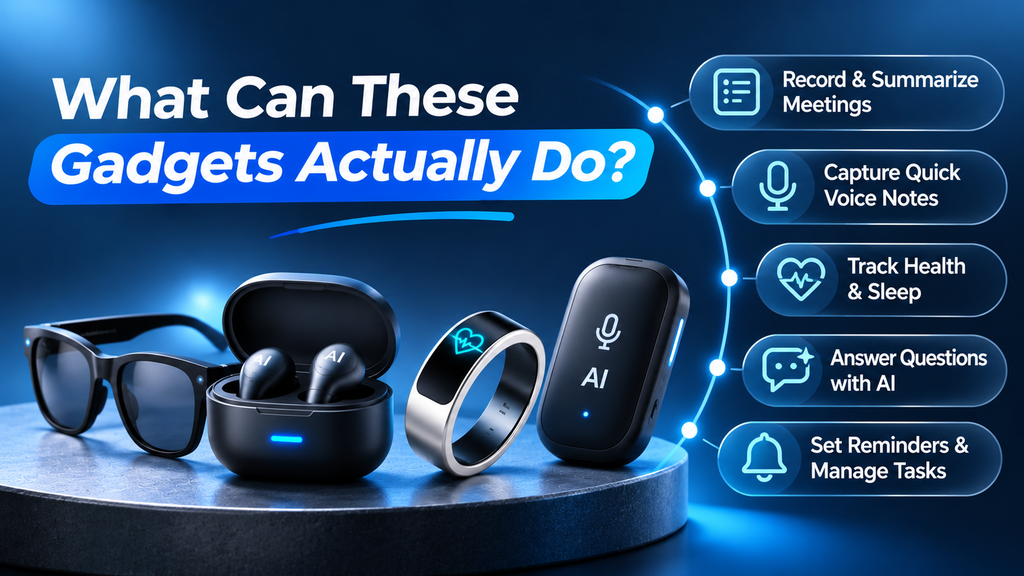
The most useful screen-free AI gadgets focus on specific everyday problems rather than promising to do everything.
| Task | Possible device | What to check |
|---|---|---|
| Meeting summaries | AI note-taker | Transcription quality and consent |
| Quick voice notes | Voice recorder or wearable | Recording controls and export |
| Sleep tracking | Smart ring | Sensor accuracy and app features |
| Hands-free questions | AI earbuds | Assistant compatibility |
| Visual assistance | Smart glasses | Camera, privacy and phone dependency |
| Reminders and task capture | AI wearable | Integrations and reliability |
The best product is not necessarily the one with the most AI features. It is the one that performs a useful task consistently, with minimal effort.
Screen-Free AI Gadgets vs Smartphones: Which Is Better?
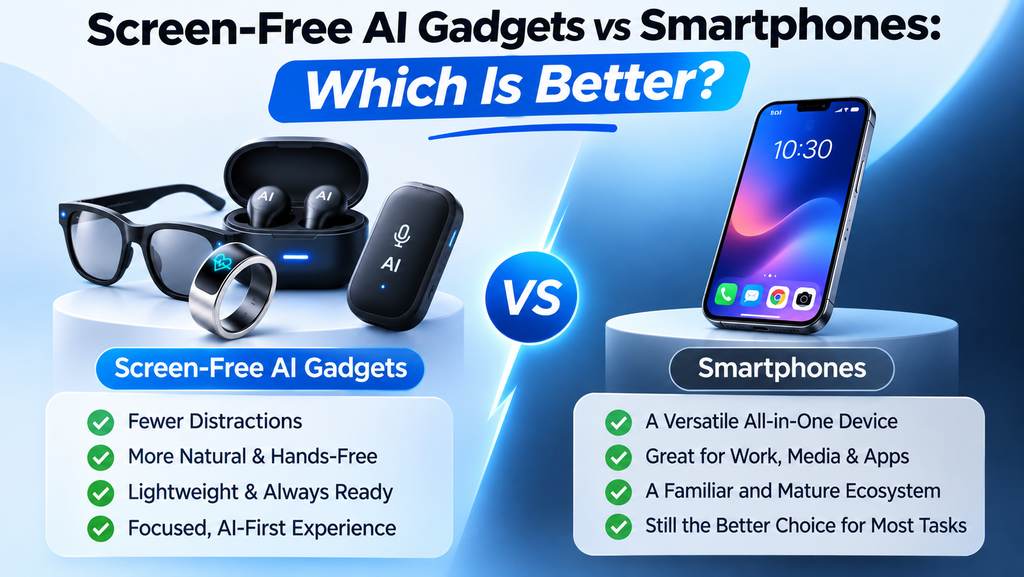
A screen-free device is not automatically a replacement for a smartphone. The two are designed for different kinds of interaction.
| Feature | Screen-Free AI Gadget | Smartphone |
|---|---|---|
| Interaction | Often voice, buttons or sensors | Touch, voice and apps |
| Portability | Depends on the device | Usually carried daily |
| Screen access | No built-in display or limited display | Full display |
| Main purpose | Specialized tasks | General-purpose computing |
| Battery | Separate device to charge | One main device |
| App support | Often limited or companion-based | Large app ecosystem |
| Best for | Hands-free or focused tasks | Broad everyday use |
For most people, a smartphone remains the more flexible option. A screen-free gadget makes sense when it offers a specific advantage, such as easier recording, less distraction or more convenient hands-free interaction.
If the new device simply repeats features already available on a phone, it may not justify the extra cost.
The Humane AI Pin Lesson: Why New AI Hardware Must Prove Its Value
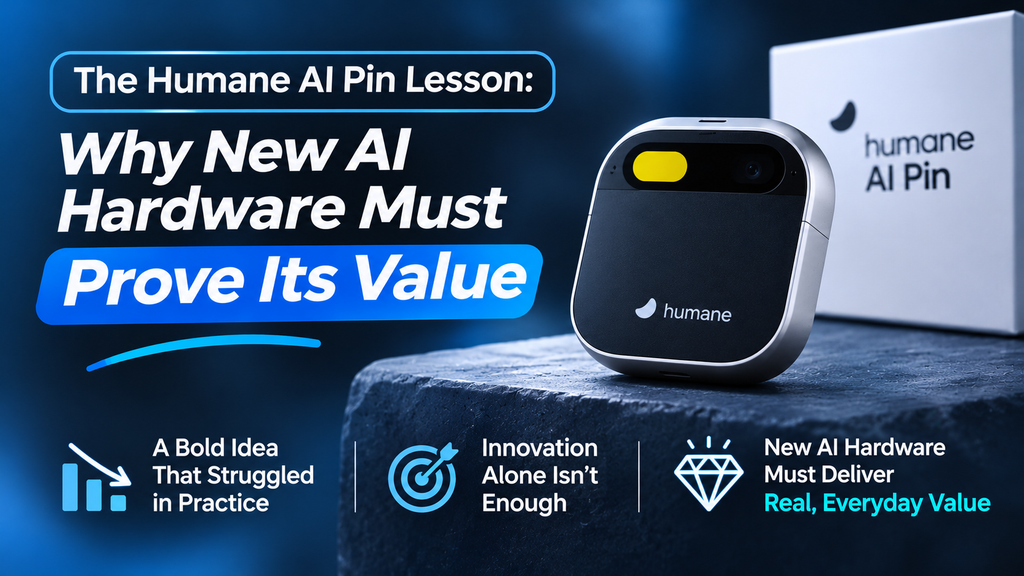
The excitement around AI hardware should be balanced with a lesson from the past.
Humane launched the AI Pin as a new kind of AI-powered wearable. It aimed to provide an assistant experience without relying on a conventional smartphone screen.
But the product did not establish a sustainable consumer business. In February 2025, Humane announced the sale of key assets to HP and discontinued sales of the AI Pin. Existing devices lost access to Humane’s cloud services on February 28, 2025, according to reporting by TechCrunch.
This matters because connected gadgets can depend heavily on the company behind them.
A device may look impressive, but what happens if its servers shut down, its subscription becomes unavailable or the company stops supporting it?
Before purchasing any AI hardware, ask:
- Does the device have useful offline features?
- Can you export your recordings and personal data?
- Does it depend on a company’s cloud service?
- What happens if the manufacturer closes the service?
- Is there a clear software-support policy?
- Can the core hardware still perform useful functions without a subscription?
The Humane AI Pin experience does not prove that every AI wearable will fail. It shows why long-term support, practical usefulness and a sustainable business model matter just as much as the launch presentation.
Privacy: The Biggest Question Around Always-Available AI Gadgets
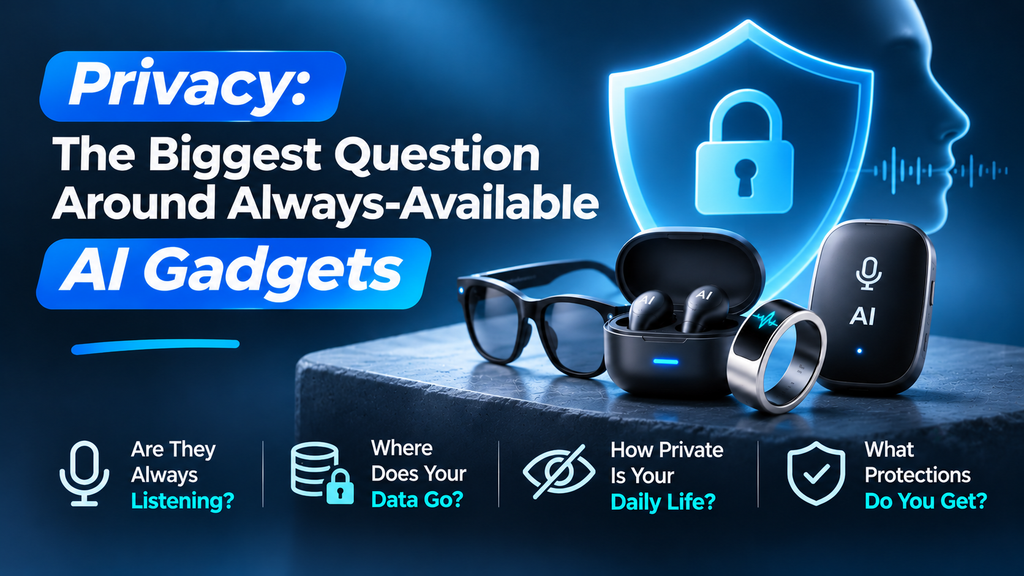
A device that listens, records or observes its surroundings can create privacy concerns—not only for its owner but also for people nearby.
Consider a meeting where one person wears an AI recorder. The wearer may know that the device is capturing audio, but other participants may not.
This creates important questions about consent, data storage and control.
Before buying a recording-focused AI gadget, check:
- Recording indicators: Does the device clearly show when recording is active?
- Consent controls: Can you easily pause or stop recording?
- Data storage: Are recordings stored locally, in the cloud or both?
- Encryption: Does the manufacturer explain how data is protected?
- Deletion: Can you permanently delete recordings and transcripts?
- Sharing: Does the app share data with third parties?
- Permissions: Does the device collect more information than it needs?
Recording laws differ by location, and workplace or classroom policies may also apply. Always obtain appropriate consent before recording other people.
A gadget that makes recording effortless must also make privacy controls clear.
Who Should Consider Buying a Screen-Free AI Gadget?
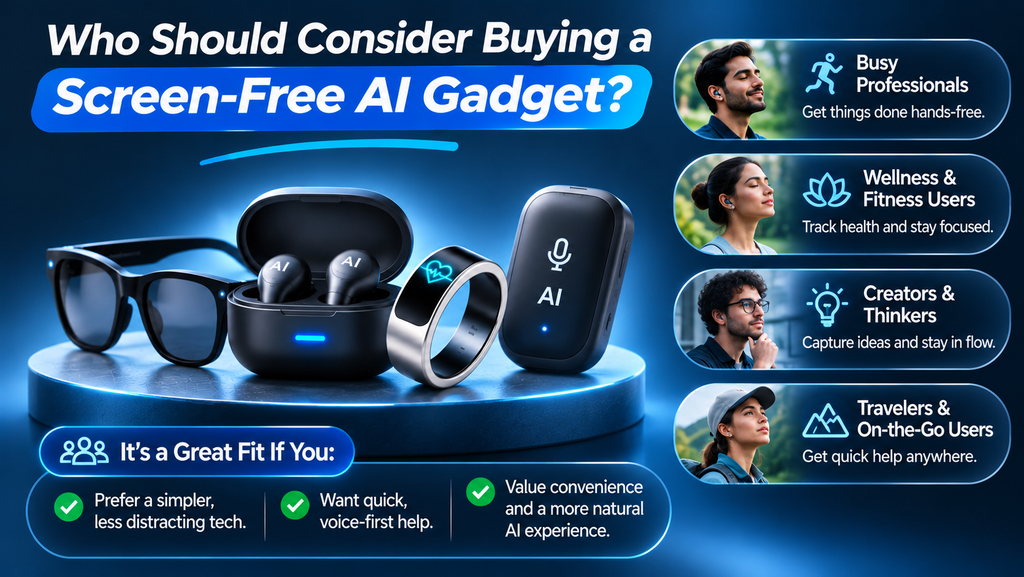
These devices can be useful, but not everyone needs one.
Professionals and remote workers: An AI note-taker may help organize meetings, interviews and action items—provided recording is permitted.
Students: A voice recorder may help capture lecture notes for later review, but students should check institutional rules and avoid relying on unverified AI summaries.
People who want fewer screen interactions: A simple wearable may make it easier to save reminders or interact with an assistant without opening a phone.
Fitness and wellness enthusiasts: A smart ring may offer a more discreet way to track selected health and activity trends.
Technology enthusiasts: Early adopters may enjoy testing new hardware, but should be comfortable with incomplete features, changing software and uncertain long-term support.
If you only need occasional voice notes or AI answers, a smartphone app may already be enough.
What to Check Before Buying an AI Gadget
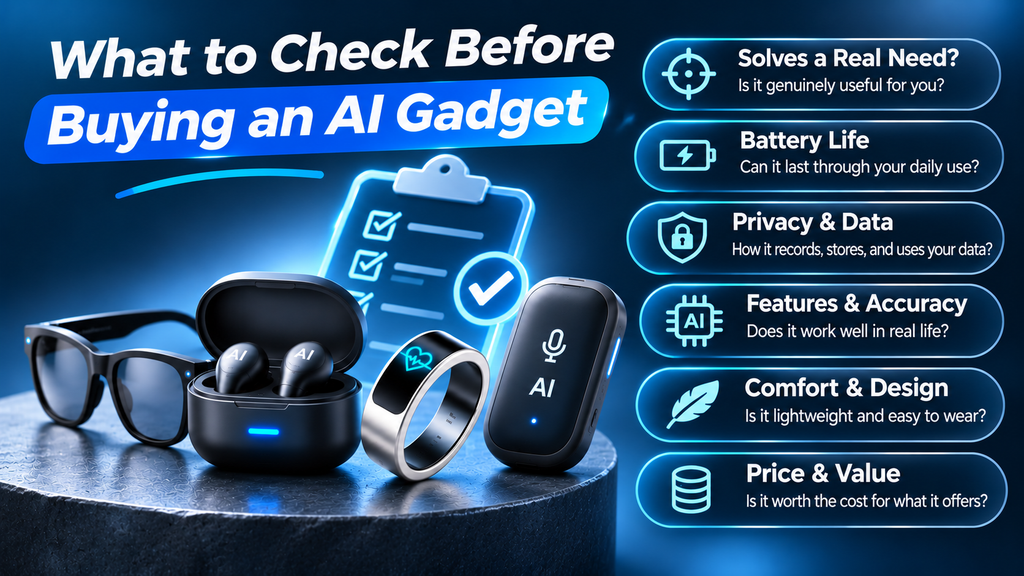
Do not buy a screen-free AI device only because it looks futuristic. Use this checklist to evaluate whether it will actually improve your daily routine.
- Purpose: What specific problem does it solve?
- Accuracy: How reliable are its summaries, measurements or responses?
- Phone dependency: Does it work independently or require a smartphone?
- Battery life: How often will you need to charge it?
- Subscription: Are important features locked behind a monthly or annual plan?
- Privacy: What data does it collect and where is it stored?
- Compatibility: Does it work with your phone, operating system and existing apps?
- Support: How long will the manufacturer provide updates?
- Data portability: Can you export your notes, recordings and other information?
- Return policy: Can you return it if the real-world experience does not match the marketing?
A useful gadget should save time or make a task easier. If it adds more steps than it removes, it may not be worth buying.
The Future of Screen-Free AI Gadgets
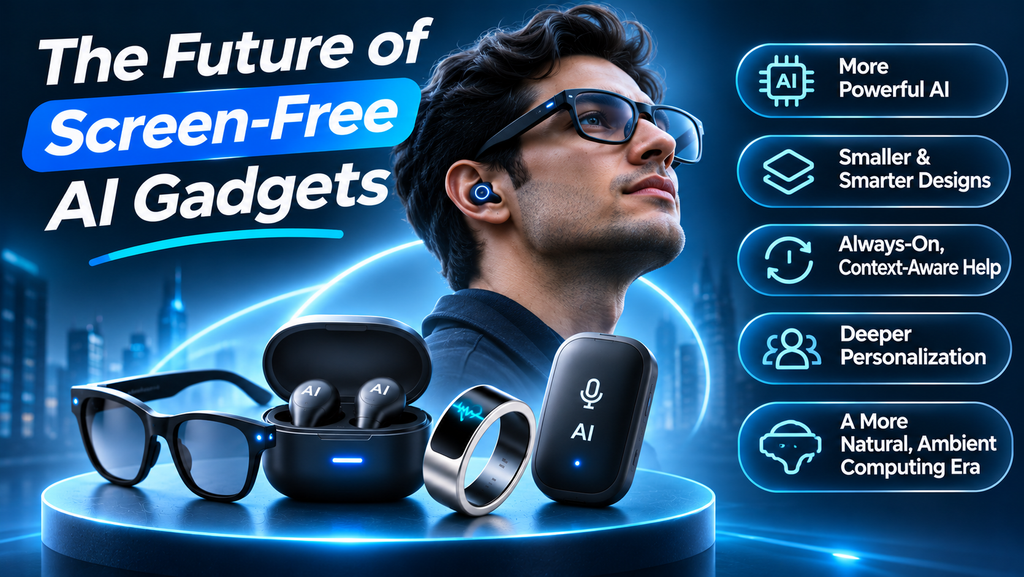
The next generation of AI hardware may focus less on replacing smartphones and more on solving small, repeated problems.
We could see more devices that capture information, summarize conversations, support hands-free tasks and connect different services. Smart rings, earbuds, glasses and dedicated AI accessories may become more capable as hardware and software improve.
But the category still faces major challenges:
- Battery life and power consumption.
- Reliable voice recognition in noisy environments.
- Privacy and consent.
- Cloud-service dependence.
- Subscription fatigue.
- Clear advantages over smartphone apps.
Nothing’s upcoming product will be an interesting test of whether a mainstream smartphone brand can make dedicated AI hardware feel genuinely useful. The real test will not be the teaser or launch event. It will be whether people continue using the device after the excitement fades.
Frequently Asked Questions
1. What are screen-free AI gadgets?
Screen-free AI gadgets are physical devices that provide selected AI features without relying on a traditional built-in display. They may use voice, buttons, microphones or sensors to help with tasks such as note-taking, reminders and hands-free assistance.
2. What is Nothing’s upcoming AI device?
Nothing CEO Carl Pei has confirmed that the company’s first AI-native product is planned to ship in December 2026. He said it would have no new screen and could not simply be replicated as an app. Its name, price and exact features have not been announced.
3. Are AI wearables worth buying?
They can be worth buying if they solve a specific problem, such as recording meetings, tracking selected health information or providing hands-free assistance. Buyers should compare their features, privacy policies, subscription costs and phone dependency before purchasing.
4. Can screen-free AI gadgets replace smartphones?
No. Most are designed for specialized tasks rather than general-purpose computing. Smartphones still offer broader app support, navigation, communication, browsing and display-based controls.
5. Are AI voice recorders safe to use?
They can be useful, but users should check recording indicators, consent requirements, encryption, cloud storage and deletion controls. Recording other people without appropriate consent can create legal and ethical problems.
6. What happened to the Humane AI Pin?
Humane discontinued AI Pin sales after selling key assets to HP in February 2025. Its cloud services for existing devices ended on February 28, 2025, demonstrating the risks of hardware that depends on a company’s online services.
7. Do AI gadgets need an internet connection?
Many AI gadgets rely on a smartphone connection or cloud services for advanced features. Some may offer limited offline functions, but buyers should check the exact requirements of each product.
8. What should I check before buying an AI wearable?
Check its real-world purpose, accuracy, battery life, compatibility, subscription fees, privacy controls, data export options and long-term software support. Do not rely only on promotional claims.
Conclusion
Buy the Solution, Not Just the AI Hype
Screen-free AI gadgets are an interesting direction for consumer technology. They could make certain tasks easier by reducing the need to open a phone, type information or switch between apps.
But the category is still developing. Nothing’s upcoming AI device adds fresh momentum to the conversation, while the experience of earlier products shows that useful features, privacy, reliability and long-term support matter more than futuristic marketing.
For buyers, the smartest approach is simple: identify the problem first, compare the device with tools you already own, and wait for real-world reviews before spending money.
The best AI gadget will not be the one that talks about the future. It will be the one that makes your everyday life a little easier.