
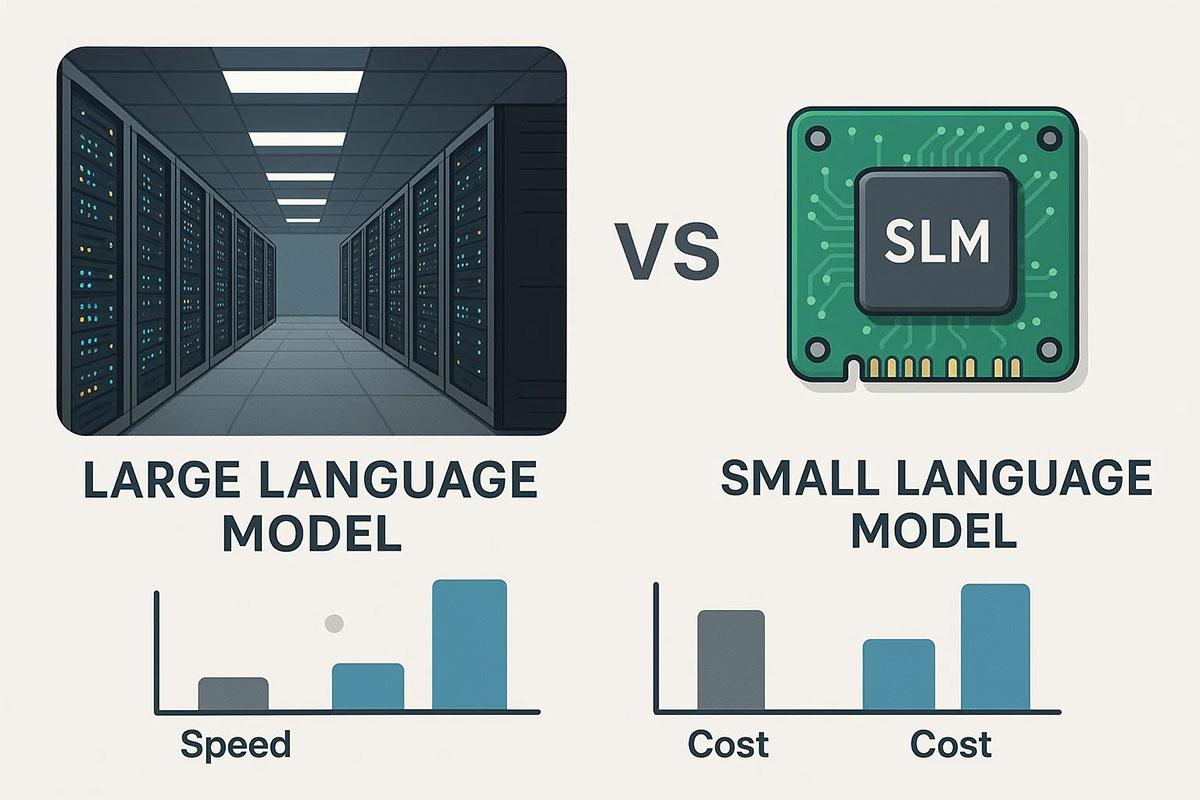
What if the best AI model for your business is not the biggest one? Small vs large language models
For the last few years, the AI industry has focused heavily on building larger and more powerful models. More parameters, bigger datasets, stronger GPUs and longer context windows have often been treated as signs of progress.
But something interesting is happening in 2026.
Developers and businesses are paying more attention to Small Language Models (SLMs). These models are designed to handle specific tasks with fewer computing resources. Some can even run directly on laptops, smartphones and other devices.
This does not mean large AI models are becoming useless. Instead, the industry is learning an important lesson: a model does not always need to be enormous to be useful.
For example, a customer support application may not need a massive AI model to answer questions about delivery status. A smaller model trained or adapted for that specific job might be faster, cheaper and easier to deploy.
So, what is the difference between small and large language models? Which one should developers and businesses choose? And can smaller models really compete with today’s powerful AI systems?
Let’s understand it in simple terms.
Why Smaller AI Models Are Getting Attention in 2026
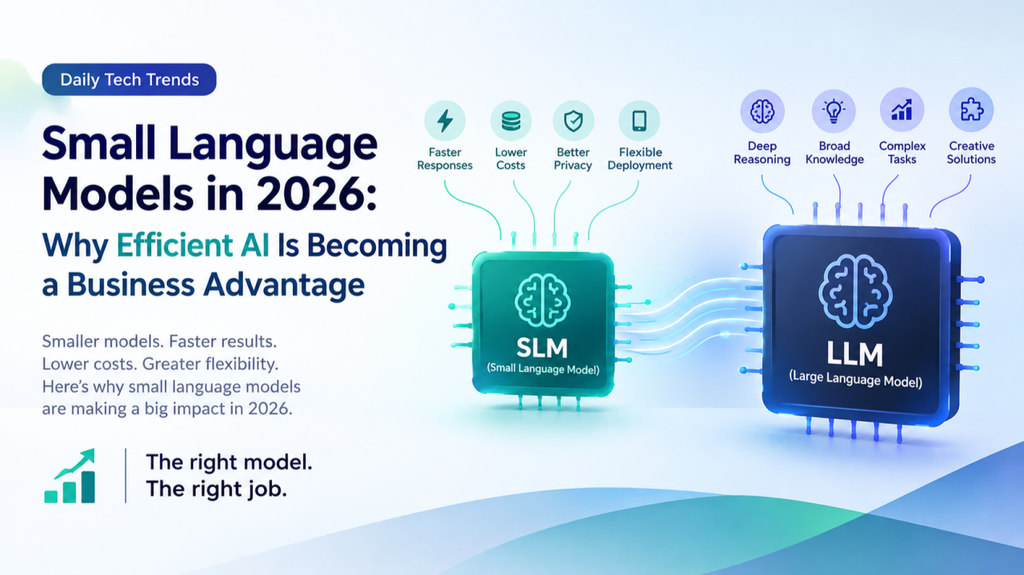
Large language models have made AI more accessible, but running them at scale can be expensive.
Every time an AI application processes a request, it uses computing resources. When thousands or millions of people use the application, those costs can become significant.
Businesses are therefore asking a practical question:
Do we really need a large AI model for every task?
In many cases, the answer is no.
A smaller model may be enough for classification, summarisation, simple question answering, text extraction and other focused tasks.
The 2026 AI and machine learning trends report from InfoQ highlights the growing attention toward small language models alongside reasoning models and AI agents. This reflects a wider shift toward choosing models based on the task instead of simply choosing the largest available option.
Google’s Gemma model family is another example. Its different model sizes are designed for different hardware environments, including mobile devices, laptops and servers.
The direction is clear: AI is moving toward more specialised and efficient deployments, not just bigger models.
What Is a Small Language Model (SLM)?
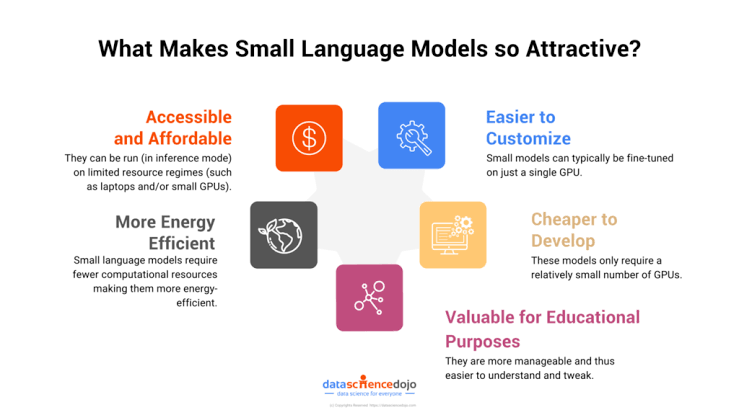
A Small Language Model is an AI model designed to understand and generate language while using fewer parameters and computational resources than many large language models.
Think of it as a specialist rather than an all-purpose expert.
A small model may be designed to:
- Classify customer support messages.
- Extract important information from documents.
- Summarise short reports.
- Answer questions about a specific product.
- Detect sentiment in customer feedback.
- Run simple AI features directly on a device.
For example, imagine an online store receiving hundreds of customer messages every hour.
Most messages may fall into a few categories:
- Where is my order?
- I want to return a product.
- My payment failed.
- I need help changing my address.
A specialised small model could classify these messages and send them to the correct workflow.
It does not need to write research papers, solve advanced mathematics or discuss every topic under the sun. It only needs to perform its assigned job reliably.
That focused approach can make small models practical for applications where speed, cost and resource usage matter.
What Is a Large Language Model (LLM)?
A Large Language Model is trained on extensive datasets and generally uses a much larger number of parameters than a small model.
These models are built to handle a broad range of language tasks.
They can help with:
- Writing and editing.
- Complex question answering.
- Coding and debugging.
- Research and analysis.
- Understanding long documents.
- Brainstorming and creative tasks.
- Reasoning through multi-step problems.
Tools such as ChatGPT, Claude and Gemini give users access to large and capable AI systems, although each product can use different model sizes and architectures.
Think of an LLM as a general-purpose assistant.
You can ask it to write an email, explain machine learning, review a code snippet or help plan a project. It can switch between different tasks without being trained from scratch for each request.
However, broader capabilities often require more computing resources. The exact cost and performance depend on the model, hardware, workload and deployment method.
Small vs Large Language Models: 7 Key Differences
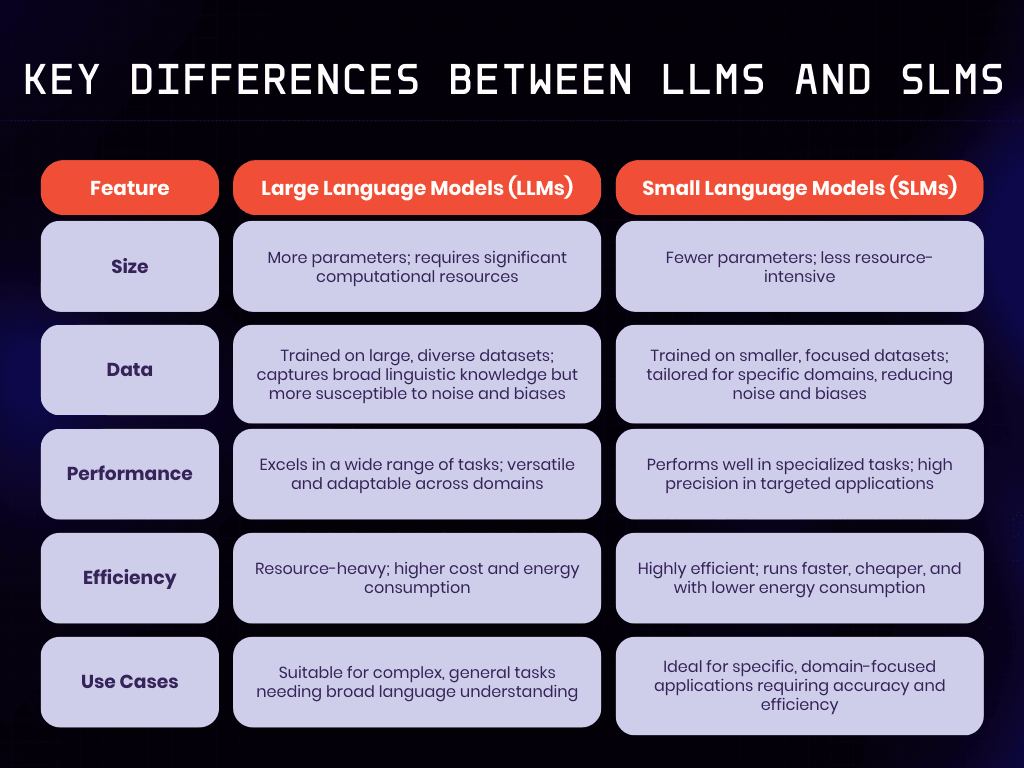
Both SLMs and LLMs are based on machine learning, but they are designed for different needs.
| Feature | Small Language Models | Large Language Models |
|---|---|---|
| Model size | Generally smaller | Generally larger |
| Computing needs | Often lower | Often higher |
| Response speed | Can be faster for suitable tasks | Depends on model and infrastructure |
| Operating cost | Can be lower | Can be higher |
| General knowledge | Usually more limited | Usually broader |
| Customisation | Practical for focused tasks | Powerful but may require more resources |
| Deployment | Can run locally or on edge devices | Often hosted on powerful servers, though smaller variants exist |
These are general tendencies, not universal rules. A poorly optimised small model can still be slow, and a well-optimised large model can be very efficient.
1. Model Size and Parameters
One of the most visible differences is the number of parameters.
Parameters are values a model learns during training. They help determine how the model processes information and generates responses.
A larger number of parameters does not automatically guarantee better results for every task.
For example, a small model trained or fine-tuned for invoice extraction may perform better on that specific job than a general-purpose model that has not been adapted for it.
The key is matching the model to the problem.
2. Computing Power and Hardware
Large models often require powerful GPUs or specialised infrastructure, especially when handling heavy workloads.
Smaller models can sometimes run on ordinary computers, laptops and even mobile devices.
Google’s Gemma family demonstrates this range of deployment options, with model variants designed for phones, laptops and more powerful systems.
This is useful when a business wants to add AI features without depending on a large cloud infrastructure for every request.
3. Cost of Running AI
Running an AI model involves more than its initial development.
Businesses may need to pay for:
- GPU or server infrastructure.
- Cloud hosting.
- Electricity and cooling.
- Model maintenance.
- Monitoring and evaluation.
- Data storage and networking.
Smaller models can reduce some of these costs because they often need fewer computing resources.
For example, a company processing thousands of short support messages may find a specialised SLM more economical than sending every message to a large model.
However, the total cost still depends on development, hosting, traffic and accuracy requirements.
4. Speed and Latency
Latency means the time a system takes to respond.
Smaller models can often produce responses quickly because they have fewer computations to perform.
This can be useful in applications that need immediate responses, such as:
- Voice assistants.
- Smart devices.
- Mobile applications.
- Real-time text classification.
- Simple automation systems.
But speed is not determined by model size alone. Hardware, quantisation, software optimisation and request length also matter.
5. Privacy and Local Deployment
This is one of the most interesting advantages of smaller models.
Some SLMs can run directly on a user’s device. When an application processes information locally, it may not need to send every input to a remote server.
Imagine a notes application that summarises your personal notes.
If the model runs locally, the application can process those notes on your device rather than automatically sending them to an external AI service.
That can reduce data transmission and improve control over sensitive information.
However, local deployment does not automatically guarantee privacy. Applications can still collect or transmit data through other features, so developers must review the complete data flow.
6. Customisation and Specialisation
Small models can be useful when an organisation needs AI for a narrow subject or workflow.
For example, a company could adapt a model to understand its internal product terminology, support categories or document formats.
One common technique is fine-tuning.
Fine-tuning takes an already trained model and continues training it on a smaller, task-specific dataset. It can require substantially less compute, data and time than training a model from scratch.
Another option is Retrieval-Augmented Generation (RAG), which gives a model access to relevant external information when answering questions.
The choice between fine-tuning and RAG depends on whether the task requires changing the model’s behaviour or giving it access to updated knowledge.
7. Accuracy and Reasoning Ability
This is where large models often have an advantage.
A powerful general-purpose model may handle complex instructions, unfamiliar topics and multi-step reasoning better than a smaller model.
But the difference depends on the task.
A small model trained for a specific classification job may be highly effective, while a large model may make unnecessary mistakes or consume more resources than the task requires.
The right way to compare models is to test them on real examples from your application.
Do not select a model just because it has more parameters or a popular name.
Real-World Examples: Where Should You Use SLMs and LLMs?
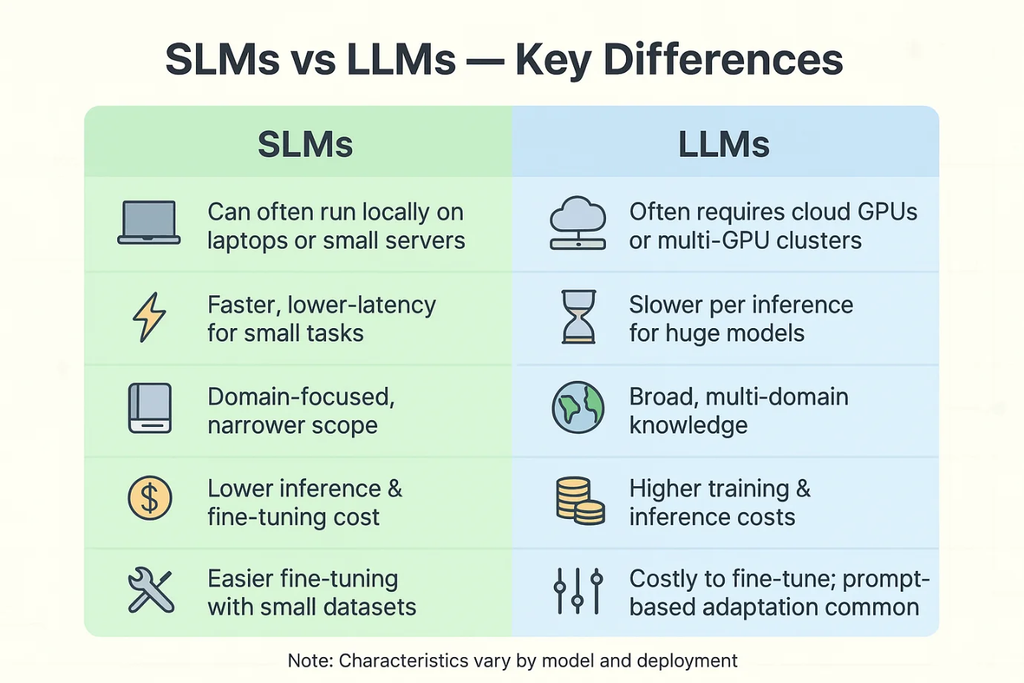
Let’s make the differences practical.
Example 1: E-commerce Customer Support
An online store receives thousands of messages every day.
A small model can classify messages into categories such as refunds, delivery, payments and product questions.
A larger model can handle complicated customer conversations that require understanding multiple issues or explaining detailed policies.
A practical system could use both: the small model handles routine requests, while the complex cases are passed to a larger model or a human support agent.
Example 2: Social Media Management
Imagine a social media manager handling comments across multiple accounts.
A small model could:
- Detect positive, negative and neutral comments.
- Identify spam.
- Categorise common questions.
- Flag comments that need attention.
A larger model could help write thoughtful replies, develop content ideas or analyse campaign performance.
This combination can make daily work more efficient without using a large model for every simple task.
Example 3: Healthcare Applications
A hospital may use a specialised model to help organise administrative documents or classify routine requests.
A larger model may help summarise lengthy medical literature for qualified professionals.
However, medical applications require strong privacy, accuracy, validation and human oversight. AI output should not replace professional medical judgement.
Example 4: Offline Mobile Applications
Imagine travelling somewhere with a weak internet connection.
An application with a suitable on-device model could still provide basic translation, text assistance or voice features without relying on a constant cloud connection.
This is one reason efficient models are attracting attention from mobile and edge-AI developers.
How Do Developers Make Small Models More Powerful?
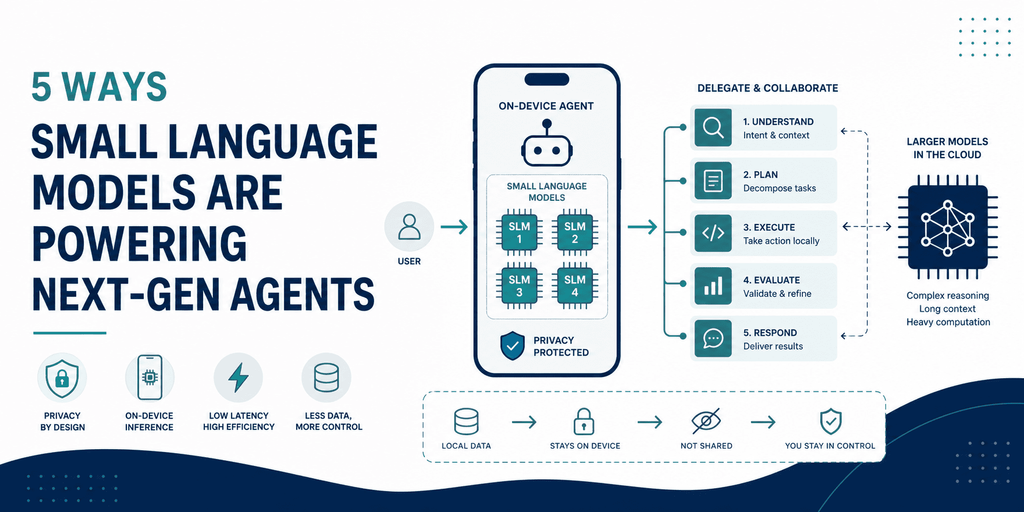
A small model is not simply a large model with fewer parameters. Developers use several techniques to make smaller models useful.
Quantisation
Quantisation reduces the numerical precision used to store model weights.
For example, a model may use 8-bit or 4-bit representations instead of higher-precision values.
This can reduce memory requirements and make deployment easier, although performance and accuracy may change depending on the model and quantisation method.
Fine-Tuning
Fine-tuning adapts a pre-trained model to a particular task using relevant examples.
For instance, a general model could be fine-tuned on product support conversations to improve its ability to answer questions about a particular catalogue.
Knowledge Distillation
Knowledge distillation uses a larger teacher model to help train a smaller student model.
The goal is to transfer useful behaviour into a more compact model.
It can be helpful when developers want a smaller system that performs well on a defined set of tasks.
Retrieval-Augmented Generation (RAG)
RAG connects a model to an external knowledge source.
Instead of relying only on information stored in its parameters, the model retrieves relevant documents and uses them to create an answer.
This is especially useful for company knowledge bases, product documentation and frequently updated information.
How to Choose the Right AI Model for Your Project
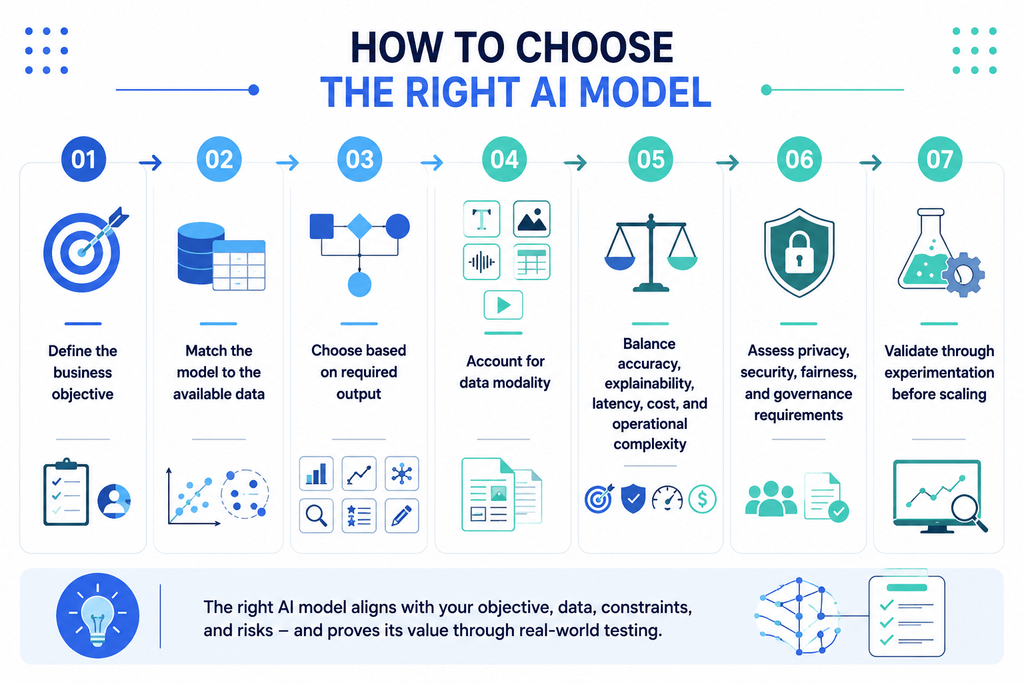
Before selecting a model, ask what you actually need it to do.
Use this simple decision guide:
| Your requirement | A practical starting point |
|---|---|
| Basic text classification | Small model |
| Short summaries | Small or medium model |
| Simple customer support | Small model with RAG |
| Complex research and analysis | Larger model |
| Advanced coding assistance | Capable larger model |
| Offline mobile AI | On-device small model |
| Multiple complex tasks | Larger model or a hybrid system |
| Sensitive local processing | Evaluate a locally deployed model |
You should also test the model using real inputs.
Measure response quality, latency, cost, reliability and failure rates. If the model makes mistakes, check whether fine-tuning, better retrieval or a different model would solve the problem.
A small model that performs reliably on your actual workload can be more valuable than a much larger model that is expensive and unnecessary.
Can Small Language Models Replace Large AI Models?
Not completely.
Small language models are becoming more capable, but they are not universal replacements for large models.
A smaller model may work brilliantly for a focused task but struggle with unfamiliar questions, complex reasoning or instructions involving multiple steps.
Large models remain useful when applications need broad knowledge, flexible reasoning and support for many different tasks.
The more practical direction is a hybrid AI architecture.
In this setup:
- A small model handles simple and repetitive requests.
- A larger model receives complex questions.
- RAG provides relevant information when needed.
- Human reviewers handle sensitive or high-risk decisions.
This approach can balance cost, speed and capability.
The Future of Machine Learning: Smaller, Smarter and More Specialised AI

Machine learning is not moving in only one direction.
Large models continue to improve, but smaller models are making AI more practical in places where powerful cloud infrastructure is not available or necessary.
We are likely to see more applications that combine multiple models, each selected for a particular task.
For developers, this creates opportunities to build AI features that are faster, more affordable and easier to deploy.
For businesses, it means they can think beyond the question of which AI model is the most powerful.
The better question is:
Which model solves my problem reliably, at a cost and speed that make sense?
That is the shift worth watching in 2026.
Frequently Asked Questions
1. What is the main difference between SLM and LLM?
A Small Language Model generally uses fewer parameters and computing resources, while a Large Language Model is designed to handle a broader range of tasks and may require more infrastructure.
2. Are small language models better than large language models?
Not in every situation. Small models can be better for focused tasks where speed, cost and local deployment matter. Large models are often more suitable for complex reasoning and general-purpose applications.
3. Can small language models run on smartphones?
Yes. Some models are specifically designed for mobile and edge devices. Actual performance depends on the model, device hardware, memory and application requirements.
4. Are small language models more private?
They can support better privacy when they process data locally instead of sending it to a remote server. However, privacy also depends on how the application handles, stores and shares information.
5. What is an example of a small language model?
Google’s Gemma family includes smaller variants designed for mobile devices and laptops. The specific model you choose should depend on your hardware and task requirements.
6. Can I fine-tune a small language model?
Yes. Developers can adapt pre-trained models using task-specific datasets and techniques such as parameter-efficient fine-tuning. The quality of the data and evaluation process matters.
7. What is the difference between a small language model and a traditional machine learning model?
A traditional machine learning model may be designed for a specific task, such as predicting prices or detecting fraud. A small language model is designed to process and generate language, although it can also support other application workflows.
8. Should businesses use SLMs or LLMs?
Businesses should start with the task, not the model size. Small models can handle routine and specialised work, while larger models can be reserved for complex tasks. A hybrid approach may be the most practical option.
Final Verdict
The rise of small language models does not mean large AI models have reached their limit.
It means the AI industry is becoming more practical.
Instead of sending every request to the biggest available model, developers can choose smaller systems for focused tasks and larger systems when more capability is needed.
For students, developers, freelancers and businesses, understanding this difference is becoming an important part of understanding modern machine learning.
The future may not belong to the biggest model alone. It may belong to the right model for the right job.