
Artificial intelligence is changing how digital art is created, shared, and experienced online. From character illustrations to photorealistic images, AI-powered tools allow people to turn written descriptions into visuals in seconds. One internet culture topic increasingly intersecting with this technology is Rule 34.
AI Rule 34 refers to the use of artificial intelligence to create adult-themed or NSFW artwork associated with the internet’s Rule 34 meme. It raises questions about creative freedom, consent, copyright, deepfakes, and the responsibility of AI platforms.
The technology can make digital illustration more accessible, but it also creates serious risks when people use it to produce sexualized images of real individuals without permission. Understanding both sides is essential to understanding where AI-generated art is heading.
What Is Rule 34?
Rule 34 is an internet meme that expresses the idea that if something exists, someone has probably created adult-themed content about it. It is an informal internet saying, not a law, official policy, or technical standard.
The phrase became part of online culture as fan communities expanded and digital art became easier to publish and distribute. It has been used in discussions of fictional characters, fandoms, illustrations, memes, and other forms of online creativity.
AI image generators have added a new dimension to this culture. Instead of drawing every detail manually, a user can describe a visual concept and ask a model to generate an image. The result depends on the tool, the prompt, the model’s training, and its safety restrictions.
Importantly, Rule 34 does not give anyone permission to use another person’s likeness, ignore copyright, or create illegal content. An internet meme does not override consent, platform rules, or applicable law.
How Is AI Changing Rule 34 Art?
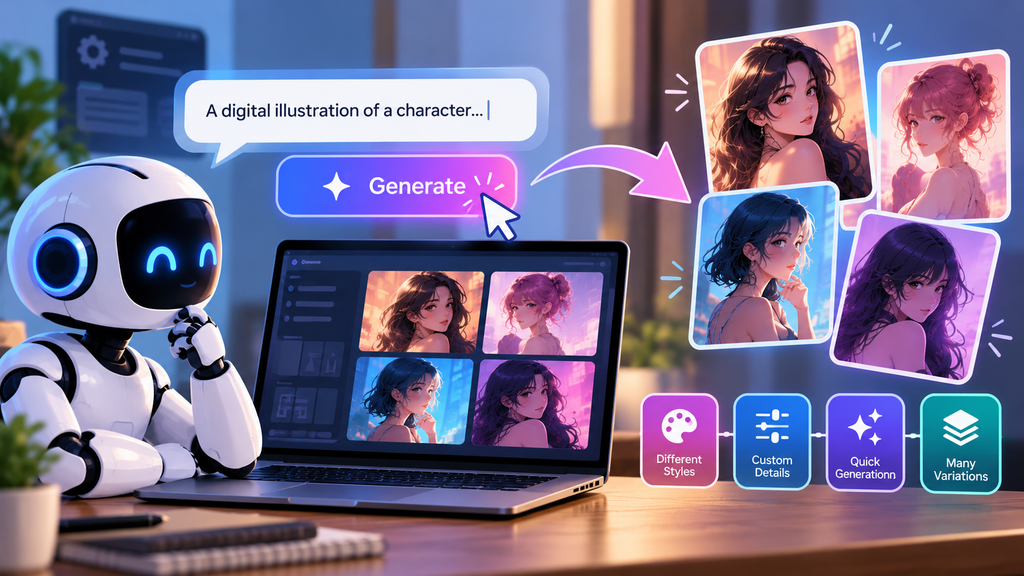
Traditional digital illustration can require drawing skills, suitable software, and considerable time. Generative AI changes that process by allowing users to produce images from text prompts, reference images, or other supported inputs.
Here are some of the main changes.
1. Text-to-image generation
Text-to-image models translate written descriptions into visual outputs. A user can describe a fictional adult character’s appearance, clothing, pose, background, lighting, and artistic style.
The model then generates an image based on patterns learned during training. Results vary, and users may need several attempts to achieve a particular look.
2. Faster visual experimentation
AI tools can make it quicker to explore different compositions, color palettes, environments, and illustration styles. Artists may use them for rough concepts before refining the work manually.
However, faster generation does not automatically mean better art. Hands, anatomy, text, perspective, and small details can still contain errors.
3. More accessible creative tools
Some AI art platforms offer simple interfaces that require little drawing experience. This can help beginners explore visual storytelling and learn about composition.
Accessibility also creates challenges. People can generate and distribute images at a scale that would be difficult with traditional manual workflows, increasing the importance of moderation and responsible use.
4. Greater debate over ownership
AI-generated art raises questions about who deserves credit: the person writing the prompt, the artist whose work influenced the model, the platform providing the technology, or someone who substantially edits the result.
The answer depends on the facts, applicable law, and the amount of human creative contribution. A prompt alone does not automatically settle ownership or copyright questions.
Why Is AI-Generated Adult-Themed Art Attracting Attention?
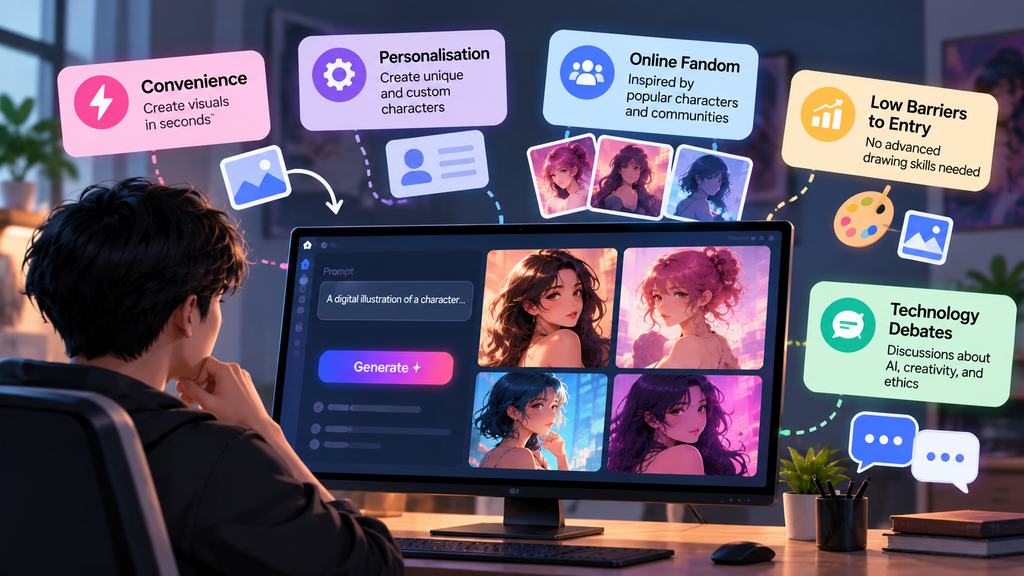
The interest is connected to several wider developments in digital culture.
Convenience: Generative tools can produce visual concepts much faster than many traditional workflows.
Personalisation: Users can experiment with fictional characters, aesthetics, and imaginary settings, subject to the tool’s capabilities and rules.
Online fandom: Digital communities have long created and discussed fan art. Generative AI introduces another method of producing visual interpretations.
Low barriers to entry: Users who lack advanced illustration skills may still be able to experiment with visual ideas.
Technology debates: Discussions about AI art often attract attention because they combine new technology with familiar questions about creativity, identity, privacy, and ownership.
These factors explain the interest in the topic, but they do not establish that every AI platform allows adult content. Many mainstream image generators restrict sexually explicit material, non-consensual sexual imagery, or other prohibited uses.
Benefits and Limitations of AI-Generated Art
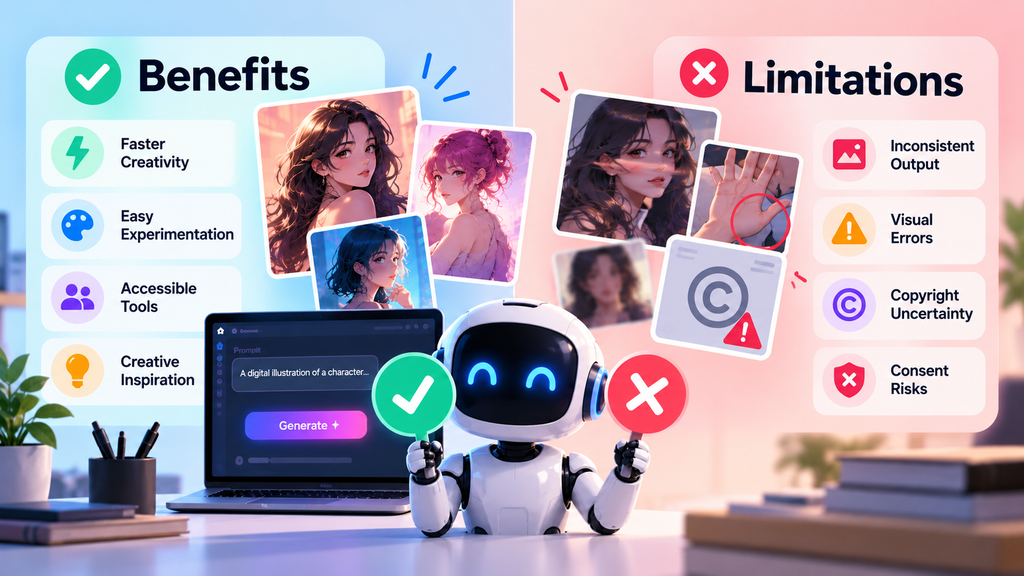
AI can be a useful creative assistant, but it is not a replacement for judgment, skill, or responsible decision-making.
Potential benefits
- Rapid concept development: Creators can explore visual directions before committing to a final design.
- Style experimentation: Users can compare different artistic approaches and compositions.
- Learning opportunities: Beginners can study lighting, framing, and visual storytelling.
- Creative assistance: Artists can use suitable AI features to support ideation, editing, or background development.
Important limitations
- Inconsistent output: Generated images can contain visual mistakes or fail to follow instructions accurately.
- Unclear provenance: It may be difficult to establish which training materials influenced a particular output.
- Copyright uncertainty: Legal protection for AI-generated works varies by jurisdiction and circumstances.
- Consent risks: Tools can be misused to create sexualized images of real people without permission.
- Platform restrictions: A tool’s terms may prohibit certain prompts, uploads, outputs, or distribution practices.
AI-generated work should therefore be assessed on more than appearance. Its origin, intended use, permissions, and potential impact on other people also matter.
The Biggest Concern: Consent and AI Deepfakes
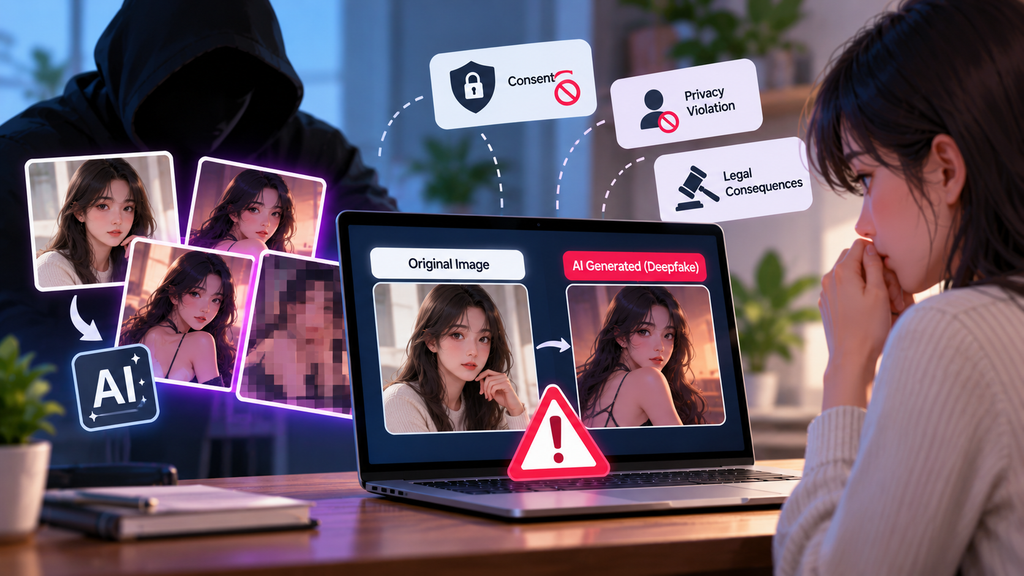
Consent is one of the most important issues in AI-generated adult imagery.
A person might upload an ordinary photograph and use an AI tool to manipulate it into a sexualized image. Another person might generate a realistic image that falsely appears to depict a real individual. Such content can cause reputational damage, harassment, emotional distress, and privacy violations even when the image is fabricated.
This is commonly discussed under the broader issue of non-consensual intimate imagery, including sexual deepfakes.
The key distinction is that being able to generate an image does not mean having permission to create or distribute it.
Responsible AI use means avoiding sexualized depictions of real people without their explicit consent, not uploading someone else’s private images into questionable services, and not using AI to harass, threaten, impersonate, or exploit anyone.
Images involving minors or depicting minors in sexual situations are especially serious and must never be created, requested, or shared. Fictional framing should not be treated as a way to bypass applicable safety rules or laws.
Copyright and Digital Creator Rights
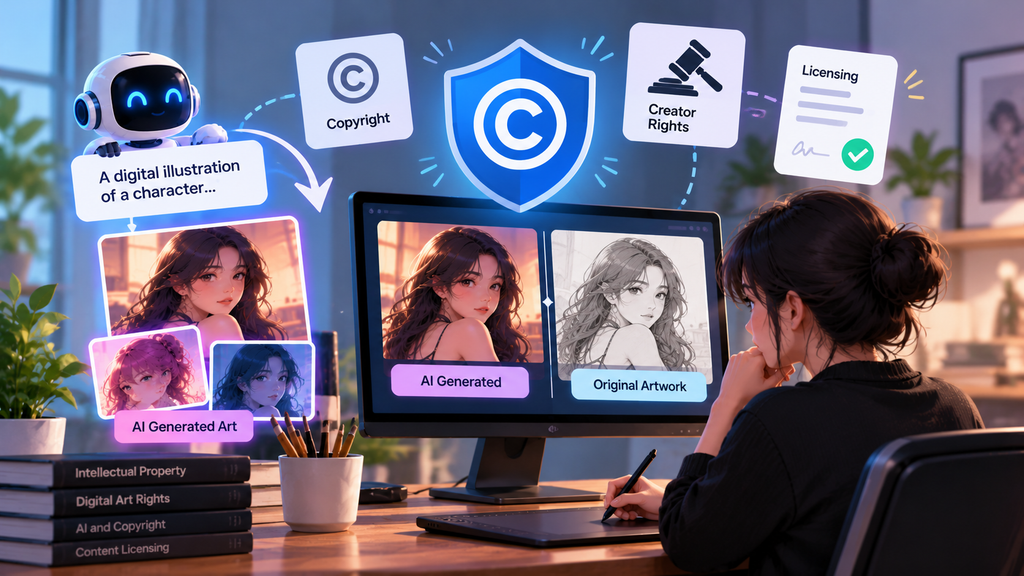
AI-generated art also raises difficult questions for illustrators, photographers, designers, and other creative professionals.
Some concerns involve whether copyrighted works were used to train a model, whether a generated result copies a protected character or a distinctive work, and whether a particular output qualifies for copyright protection.
These are different legal questions. The fact that a model produces an image does not, by itself, establish that the output infringes copyright. Similarly, describing an image as AI-generated does not automatically make it legally unrestricted.
Creators should check the licence and terms of the tools they use, particularly before selling or commercially publishing generated work. They should also avoid assuming that an image found online is free to reuse.
Where a project involves a recognisable character, an artist’s distinctive work, or a real person’s likeness, permission and legal review may be appropriate.
What Do Laws and AI Platform Rules Say in 2026?
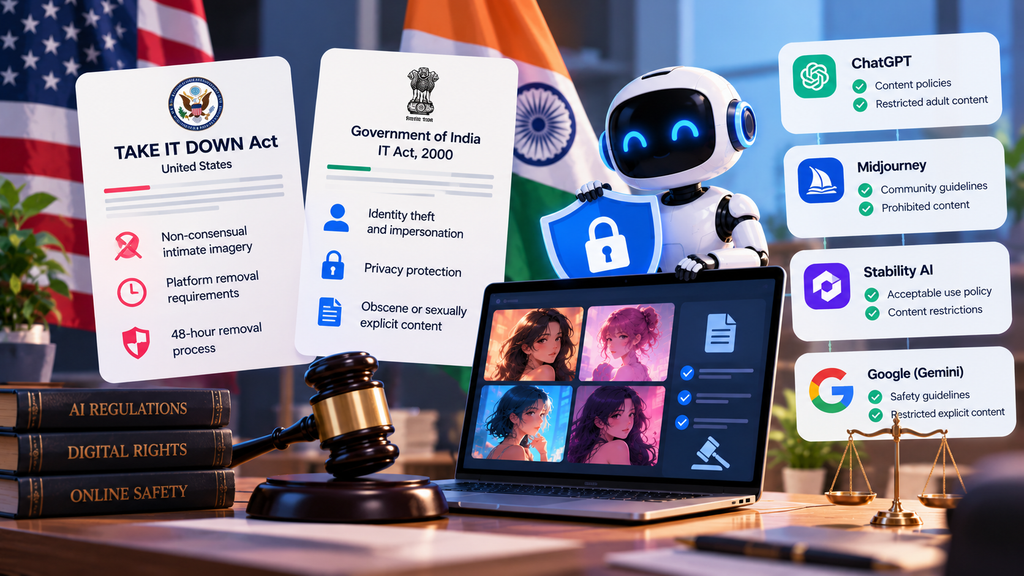
Rules differ across countries and platforms, so there is no single worldwide rule covering every AI-generated adult image.
Recent developments show that the issue is moving beyond online debate.
United States: TAKE IT DOWN Act
The United States enacted the TAKE IT DOWN Act on May 19, 2025. The law addresses the non-consensual disclosure of intimate visual depictions, including certain digitally created or altered depictions.
The US Federal Trade Commission explains that, from May 19, 2026, covered platforms must provide a process for requesting removal of qualifying non-consensual intimate imagery and remove covered content and known identical copies within 48 hours of a valid request.
Official sources:
India: Deepfake and sexually explicit content concerns
In India, the Information Technology Act, 2000 includes provisions addressing matters such as identity theft, impersonation, privacy violations, and publishing or transmitting certain obscene or sexually explicit content. The specific legal position depends on the conduct, content, and circumstances.
In July 2026, India’s Press Information Bureau published an update on government measures addressing AI-generated deepfakes and digital safety.
Official source:
These examples do not mean every AI-generated adult-themed illustration is automatically illegal. They do show why consent, distribution, age, context, and jurisdiction matter.
This section is general information, not legal advice. Anyone dealing with a specific incident should consult a qualified legal professional in the relevant jurisdiction.
How to Use AI Art Tools Responsibly
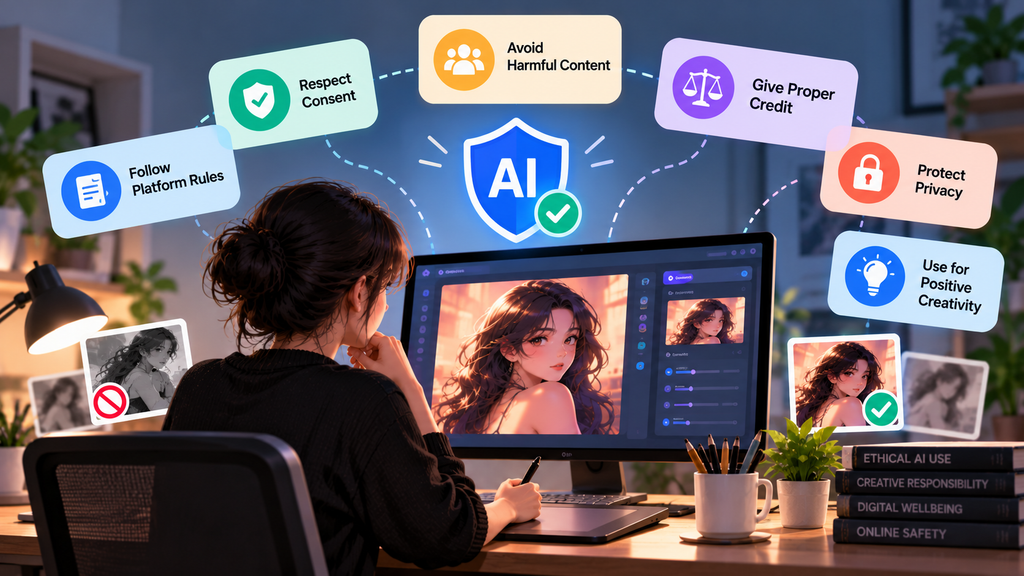
If you use generative AI for digital artwork, a few basic practices can reduce risk.
- Respect real people’s consent. Do not create or distribute sexualized images of identifiable people without their permission.
- Follow the tool’s rules. Review the platform’s acceptable-use policy and restrictions before generating or uploading content.
- Protect private information. Avoid uploading private photographs or sensitive material to services you do not trust.
- Check licences before commercial use. Review the terms for generated outputs, reference images, and any assets used in the final work.
- Be transparent when it matters. Clearly label synthetic imagery where required by law, platform rules, or the context in which it is shared.
- Do not target or harass people. Never use generated imagery for blackmail, impersonation, bullying, or humiliation.
- Report abusive content. If an image of you is shared without consent, preserve relevant evidence, report it to the platform, and seek appropriate legal or support resources.
These principles apply to AI-generated imagery broadly, not only to Rule 34-related discussions.
The Future of AI-Generated Art
AI image generation will likely continue to evolve as models improve their visual quality, editing capabilities, and integration with creative software. At the same time, platforms face pressure to make their systems safer and respond more effectively when generated imagery is abused.
Three developments will be worth watching.
Better content safeguards: Providers may continue refining moderation systems, age-related protections, and processes for reporting harmful images.
More debate about creator rights: Questions about training data, attribution, licensing, and human creative contribution will remain important to artists and technology companies.
Stronger focus on authenticity: As synthetic imagery becomes more convincing, audiences and platforms will need better ways to understand where images came from and whether they have been altered.
No single technology can resolve these challenges on its own. Effective safeguards require a combination of responsible product design, clear policies, legal protections, and informed users.
Final Thoughts
AI Rule 34 sits at the intersection of internet culture and generative technology. AI tools make it easier to experiment with digital visuals, but the same capabilities can be misused to violate privacy, ignore consent, and exploit real people.
The most useful way to understand this trend is to look beyond the shock value of the topic. The larger questions concern how society protects personal identity, respects creative work, and sets boundaries for powerful image-generation systems.
As AI art becomes more accessible, responsible creation and distribution will matter just as much as the technology itself. Creativity can evolve with AI, but consent, safety, and accountability should remain non-negotiable.
Frequently Asked Questions
1. What does AI Rule 34 mean?
AI Rule 34 describes the use of generative AI to create adult-themed or NSFW artwork associated with the internet meme known as Rule 34. The phrase is not an official law or technical standard.
2. Is Rule 34 a law?
No. Rule 34 is an informal internet meme. It does not override copyright law, privacy protections, consent requirements, or platform policies.
3. Can AI generate adult-themed artwork?
Capabilities vary by model and platform. Some tools restrict sexually explicit material or other adult content, while policies differ between services. Users should review each platform’s current rules.
4. Is AI-generated NSFW art legal?
There is no universal answer. Legality depends on factors such as the content, the people depicted, consent, distribution, age, and the applicable jurisdiction. Non-consensual sexual imagery can trigger serious legal consequences.
5. Can AI-generated images violate someone’s privacy?
Yes. A synthetic image can misuse a person’s likeness or expose them to harassment even if the image does not depict a real event. Creating or distributing sexualized imagery of someone without permission can cause significant harm and may violate applicable law.
6. Who owns AI-generated artwork?
Ownership depends on the jurisdiction, the human creative contribution, the source material, and the relevant tool licence. AI involvement alone does not settle every copyright question.
7. How can someone report a non-consensual AI image?
Report the image through the hosting platform’s abuse or privacy process. Save relevant evidence where safe and lawful, avoid resharing the image, and consider contacting appropriate authorities or a qualified legal professional. Available removal options depend on the jurisdiction and platform.
8. What is the difference between AI art and an AI deepfake?
AI art is a broad category of machine-generated or AI-assisted imagery. A deepfake generally refers to synthetic or manipulated media that imitates a real person or event. Deepfakes can be used for legitimate creative purposes, but non-consensual sexual deepfakes pose serious risks.
9. Will AI replace digital artists?
AI may automate parts of the creative workflow, but it does not eliminate the need for human judgment, storytelling, art direction, editing, and original ideas. Its impact will differ across creative roles and industries.