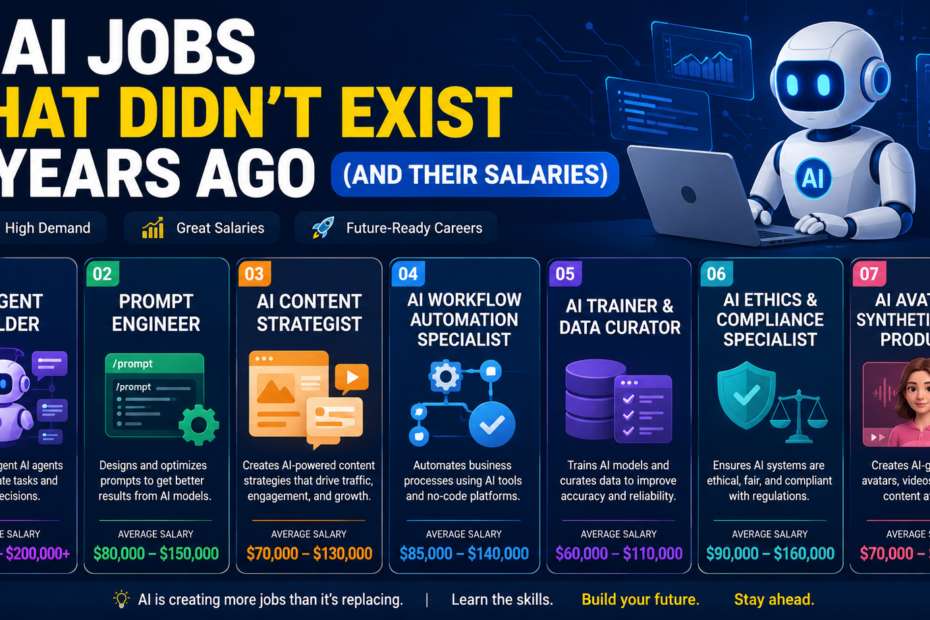
Artificial intelligence is changing the job market faster than ever before. New AI-related careers are emerging across industries such as marketing, software development, healthcare, education, and business operations. While some jobs are being automated, AI is also creating exciting new opportunities for professionals with the right skills.
In this article, we’ll explore seven AI jobs that barely existed two years ago but are now in high demand in 2026. You’ll learn what these roles involve, the skills required, and how much they can pay. Keep in mind that salaries can vary depending on your experience, location, and employer.
Why AI Jobs Are Exploding in 2026
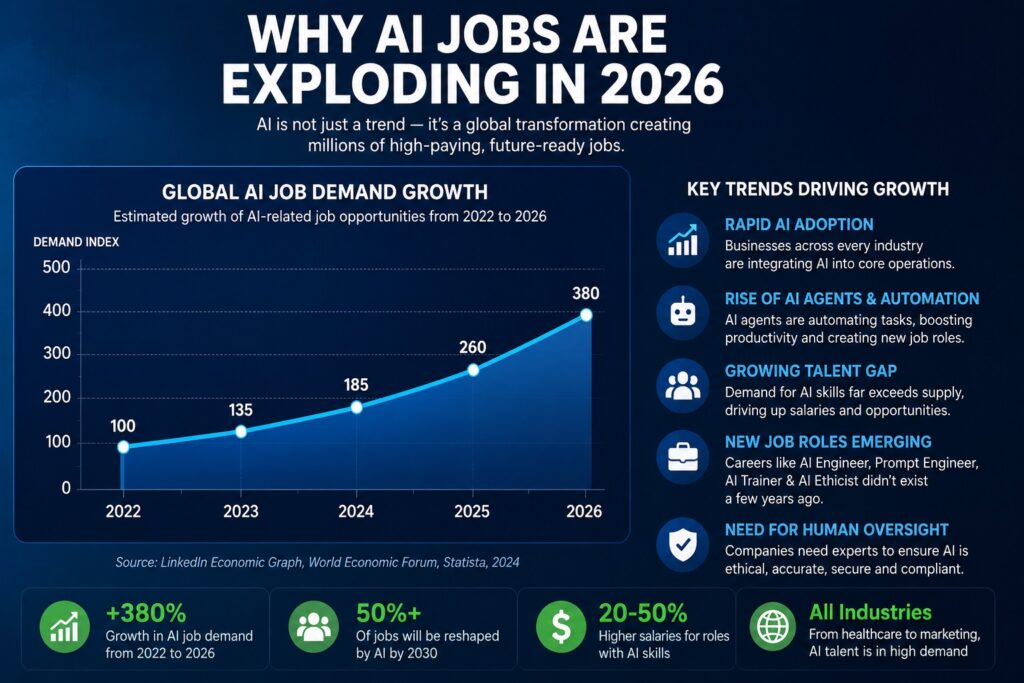
The rapid adoption of artificial intelligence is transforming the job market at an unprecedented pace. While many people worry about AI replacing jobs, the reality is more complex. AI is creating a wide range of new career opportunities across technical, business, and governance functions. Demand remains strong for traditional roles such as AI engineers, machine learning engineers, data scientists, and MLOps specialists who build, train, and maintain AI systems. At the same time, a new generation of hybrid positions—including prompt engineers, AI product managers, AI consultants, and solutions architects—is emerging to help businesses integrate AI into their daily operations. Organizations are also hiring AI ethics specialists, compliance managers, and risk analysts to ensure responsible and regulated AI deployment. Industry reports suggest that while AI may automate certain repetitive tasks and reshape millions of existing jobs, it is also expected to augment human work and create entirely new roles that did not exist just a few years ago. Over the next several years, more than half of employees are likely to see significant changes in how they work, requiring new skills and continuous learning. As businesses invest heavily in AI-driven productivity, automation, and innovation, the demand for professionals who can build, manage, govern, and collaborate with AI systems is growing rapidly, making AI one of the fastest-expanding career fields in 2026.
The Rise of AI Agents
The explosive growth of AI jobs in 2026 is being driven by one major trend: the rise of AI agents. These advanced systems are evolving far beyond simple chatbots and automation tools. Instead, they are becoming intelligent digital collaborators capable of learning, adapting, making decisions, and handling complex tasks with minimal human intervention. Businesses across industries are rapidly adopting AI agents to streamline operations, analyze massive amounts of data, automate workflows, and improve productivity. As these systems become more integrated into everyday work, companies need skilled professionals to build, train, manage, and supervise them.
This shift is creating entirely new career opportunities. Organizations are hiring AI engineers, AI agent developers, prompt engineers, automation specialists, AI product managers, and AI governance experts to support the growing AI ecosystem. Rather than replacing workers outright, AI agents are changing how work gets done. Teams that once required dozens of employees can now operate with a smaller group of professionals working alongside multiple AI agents. This allows businesses to scale faster, reduce operational costs, and focus more on innovation.
The growing adoption of AI agents is also creating demand for human skills that cannot be easily automated. Employees are increasingly responsible for overseeing AI systems, ensuring they operate ethically, protecting data privacy, and aligning AI outputs with business goals. As a result, AI literacy, critical thinking, and responsible AI management are becoming valuable workplace skills. Market analysts predict that the AI agent industry will continue expanding rapidly over the next several years, making it one of the strongest drivers of job creation in the technology sector.
As AI becomes a core part of business operations, professionals who understand how to work with, manage, and improve AI systems will be in high demand. The combination of technological innovation, business adoption, and the need for human oversight is why AI jobs are growing faster than ever in 2026, creating opportunities that barely existed just a few years ago.
Companies Need AI Integration
Businesses across every industry are racing to integrate artificial intelligence into their daily operations to improve efficiency, reduce costs, and stay competitive. From automating customer support and content creation to streamlining data analysis and decision-making, organizations are investing heavily in AI-powered workflows. However, the rapid pace of AI adoption has created a significant skills gap, as there are not enough qualified professionals to design, implement, and manage these systems. As a result, companies are actively hiring AI specialists, automation experts, prompt engineers, and AI consultants who can help transform traditional business processes into intelligent, AI-driven operations. This growing demand for AI integration is one of the biggest reasons AI-related careers are expanding so quickly in 2026.
- Organizations want AI workflows.
Companies are increasingly adopting AI-powered workflows to automate repetitive tasks, improve productivity, and reduce operational costs. From customer support and marketing to data analysis and project management, businesses are integrating AI into nearly every department. Organizations that successfully implement AI workflows can make faster decisions, serve customers more efficiently, and gain a competitive advantage, making AI integration a top business priority in 2026.
- Lack of skilled professionals.
While AI adoption is growing rapidly, the number of professionals with practical AI skills has not kept pace with demand. Many organizations struggle to find qualified talent who can build AI solutions, create automation systems, manage AI tools, and ensure responsible implementation. This talent shortage has created a significant opportunity for job seekers, as companies are willing to offer competitive salaries to professionals who possess AI-related skills and real-world experience.
AI Skills = Higher Salaries
Professionals with AI skills are earning significantly higher salaries than their peers because businesses view AI expertise as a valuable competitive advantage. Whether it’s building AI agents, creating automation workflows, analyzing data, or integrating AI into business operations, these specialized skills help companies save time, reduce costs, and increase revenue. As demand for AI talent continues to outpace supply, employers are offering premium compensation packages to attract and retain skilled professionals, making AI one of the most lucrative career fields in 2026.
- AI expertise commands premium compensation.
AI professionals are among the highest-paid workers in today’s job market because their skills directly contribute to innovation, efficiency, and business growth. Companies are willing to pay premium salaries for individuals who can develop AI solutions, automate complex processes, and help organizations gain a competitive edge. As AI adoption accelerates across industries and qualified talent remains limited, professionals with proven AI expertise continue to command higher compensation than many traditional technology and business roles.
1. AI Agent Builder
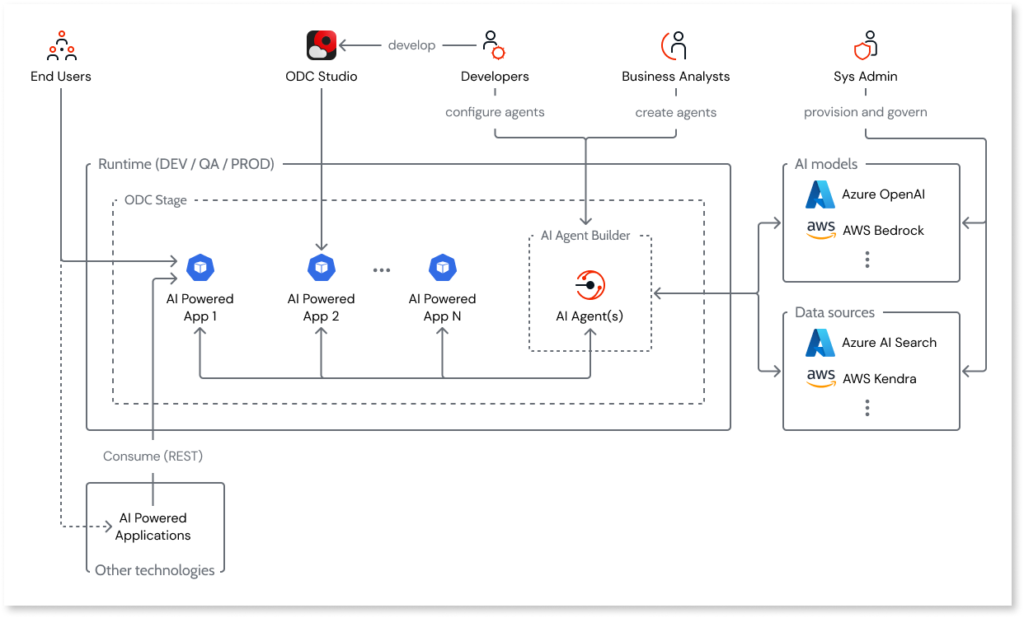
An AI agent builder is a platform that helps businesses create and deploy AI agents without needing advanced coding skills. These tools provide simple interfaces, templates, and automation features that make it easy to build AI assistants for different tasks. AI agents can handle customer support, automate workflows, answer questions, and complete routine business processes with minimal human involvement.
Most AI agent builders use technologies such as machine learning, natural language processing (NLP), and large language models (LLMs) to understand requests, make decisions, and respond intelligently. For example, a company can create an AI agent that automatically handles common IT support tasks like password resets, software access requests, and basic troubleshooting, saving employees time and improving productivity.
What They Do
AI Agent Builders design and develop intelligent AI agents that can perform tasks independently with little or no human supervision. They connect AI systems with business tools, databases, APIs, and workflows, allowing agents to automate processes, retrieve information, complete tasks, and support daily operations. Their goal is to create digital assistants that help businesses save time, increase productivity, and streamline complex workflows.
- Create autonomous AI agents.
Build intelligent AI systems that can perform tasks, make decisions, and complete workflows with minimal human intervention.
- Connect tools, databases, and workflows.
Integrate AI agents with software, databases, and business processes to automate tasks and improve efficiency.
Key Skills
To become an AI Agent Builder, professionals need a strong understanding of AI tools and automation platforms such as ChatGPT and Claude for creating intelligent AI agents. They should also be familiar with workflow automation tools like Make and n8n, which help connect different applications and automate business processes. Additionally, knowledge of APIs is essential, as APIs allow AI agents to communicate with software, databases, and external services seamlessly.
Average Salary
AI Agent Builders are among the highest-paid professionals in the AI industry due to the growing demand for automation and AI-powered business solutions. Freelancers can typically earn between $2,000 and $10,000 per project, depending on the complexity of the AI agent and the client’s requirements. Meanwhile, full-time AI Agent Builders often earn $90,000 to $180,000 per year, with experienced professionals and specialists commanding even higher salaries at top technology companies.
Why It’s Growing
The demand for AI Agent Builders is growing rapidly because businesses want to automate repetitive tasks, improve productivity, and reduce operational costs. AI agents can handle customer support, data processing, content creation, scheduling, and many other business functions without constant human supervision. As more companies adopt AI to scale their operations, the need for professionals who can build, deploy, and manage these intelligent systems continues to rise.
Companies are increasingly turning to AI agents to handle repetitive and time-consuming tasks without expanding their workforce. By automating processes such as customer support, data entry, scheduling, and reporting, businesses can improve efficiency, reduce costs, and scale operations faster. This growing demand for automation is creating strong opportunities for AI Agent Builders and other AI professionals.
2. Prompt Engineer
Prompt engineering is the skill of writing clear and effective instructions that help AI tools generate better results. By choosing the right words, structure, and context, prompt engineers guide AI systems to produce accurate, relevant, and useful responses. They test and refine different prompts to improve the quality of AI-generated content, making AI tools more effective for specific tasks and business needs.
What They Do
Prompt Engineers create, test, and optimize prompts that help AI tools generate accurate, useful, and high-quality responses. They work with businesses to improve AI performance for tasks such as content creation, customer support, research, coding, and automation.
Key Skills
Prompt Engineers need strong communication and critical-thinking skills, along with a solid understanding of AI tools such as ChatGPT, Claude, and Gemini. They should also know how to structure prompts, analyze outputs, and refine instructions to achieve better results.
Average Salary
Due to the growing demand for AI expertise, Prompt Engineers can earn between $70,000 and $150,000 per year in full-time roles. Freelancers and consultants may earn even more depending on their experience and project scope.
Why It’s Growing
As businesses increasingly adopt AI tools, they need professionals who can improve the quality, accuracy, and reliability of AI-generated outputs. Effective prompts help companies save time, reduce errors, and get better results from AI systems, making Prompt Engineering one of the fastest-growing AI careers in 2026.
3. AI Content Strategist

An AI Content Strategist uses AI tools and data to plan, optimize, and improve content marketing strategies. They analyze audience behavior, content performance, search trends, and competitor insights to identify the best topics, formats, and publishing schedules. Instead of spending hours on manual research, AI helps them make faster and smarter content decisions. This allows human marketers to focus on creativity, storytelling, and building a stronger brand while AI handles data analysis and content planning.
What They Do
AI Content Strategists use AI tools and data insights to plan content, identify trending topics, optimize SEO strategies, and improve audience engagement. They help businesses create the right content for the right audience at the right time, using AI to make content marketing more effective and data-driven.
Key Skills
AI Content Strategists need expertise in content marketing, SEO, keyword research, audience analysis, and AI-powered content tools. Familiarity with platforms such as ChatGPT, Claude, Google Analytics, and content optimization tools is also valuable.
Average Salary
AI Content Strategists typically earn between $60,000 and $130,000 per year, depending on their experience, industry, and level of AI expertise. Freelancers and consultants may earn additional income through project-based work.
Why It’s Growing
As businesses produce more digital content than ever before, they need professionals who can use AI to improve content performance and marketing results. AI helps companies create content faster, identify opportunities, and reach the right audience, making AI Content Strategists increasingly valuable in 2026.
4. AI Workflow Automation Specialist
An AI Workflow Automation Specialist is a professional who helps businesses automate their processes using AI and automation tools. Their main job is to connect AI models with different software applications, databases, and business systems to create efficient workflows that can operate with minimal human involvement. Instead of employees manually performing repetitive tasks, these specialists build automated systems that can handle work faster and more accurately.
They use platforms such as n8n, Make, Zapier, Microsoft Power Automate, and Pipedream to connect different tools and automate workflows. For more advanced projects, they may also use programming languages like Python or TypeScript to build custom automation solutions. These professionals work at the intersection of artificial intelligence, business operations, and workflow automation.
For example, an AI Workflow Automation Specialist might create a system that automatically receives customer inquiries, uses AI to understand the request, generates a response, updates the company CRM, and notifies the appropriate team member—all without manual intervention. They can also automate content creation, lead generation, data analysis, reporting, customer support, and internal business processes.
As companies continue adopting AI to improve productivity and reduce costs, AI Workflow Automation Specialists are becoming increasingly valuable. They help organizations save time, eliminate repetitive work, and scale operations more efficiently, making this one of the fastest-growing AI careers in 2026.
What They Do
AI Workflow Automation Specialists design and build automated systems that connect AI tools, business software, databases, and workflows. They streamline repetitive tasks, automate business processes, and create intelligent workflows that improve efficiency, reduce manual work, and boost productivity.
Key Skills
Professionals in this role need expertise in automation platforms such as n8n, Make, Zapier, and Microsoft Power Automate. They should also understand AI tools, APIs, workflow design, databases, and basic programming languages like Python or JavaScript.
Average Salary
AI Workflow Automation Specialists typically earn between $80,000 and $160,000 per year, depending on their experience, technical skills, and industry. Freelancers can also earn thousands of dollars per project by building custom automation solutions for businesses.
Why It’s Growing
Businesses are looking for ways to automate repetitive tasks, reduce operational costs, and improve efficiency without increasing headcount. As AI becomes a core part of business operations, companies need specialists who can connect AI tools with existing systems and create powerful automated workflows, making this role one of the fastest-growing careers in 2026.
5. AI Trainer & Data Curator
An AI Trainer and Data Curator is responsible for collecting, organizing, labeling, and preparing data that helps AI systems learn and improve. They ensure that the data used to train AI models is accurate, relevant, and well-structured. This can include text, images, videos, audio files, and other types of information.
These professionals play a crucial role in improving AI performance because AI systems rely on high-quality data to make accurate decisions and generate reliable results. AI Trainers and Data Curators work in industries such as healthcare, finance, marketing, technology, and media, helping organizations build smarter and more effective AI solutions.
What They Do
AI Trainers and Data Curators collect, organize, label, and manage data used to train AI models. They ensure that AI systems learn from accurate, high-quality information, helping improve the performance, reliability, and accuracy of AI applications.
Key Skills
This role requires strong attention to detail, data organization skills, quality assurance, and analytical thinking. Familiarity with data labeling tools, spreadsheets, databases, and basic AI concepts is also beneficial.
Average Salary
AI Trainers and Data Curators typically earn between $55,000 and $120,000 per year, depending on their experience, industry, and level of expertise. Specialized roles in enterprise AI projects can offer even higher compensation.
Why It’s Growing
AI systems depend on high-quality data to function effectively. As more companies develop and deploy AI solutions, the demand for professionals who can prepare, manage, and improve training data continues to increase. Without accurate data, even the most advanced AI models cannot perform well, making this role essential in the AI ecosystem.
6. AI Ethics & Compliance Specialist

An AI Ethics and Compliance Specialist ensures that AI systems are developed and used responsibly, fairly, and in line with laws and regulations. They identify potential risks such as bias, privacy concerns, and ethical issues, helping organizations build trustworthy AI solutions. As AI becomes more widely used across industries, these professionals play a crucial role in ensuring that AI technologies are safe, transparent, and aligned with societal values.
What They Do
AI Ethics and Compliance Specialists evaluate AI systems to ensure they are fair, transparent, secure, and compliant with legal and ethical standards. They identify risks related to bias, privacy, data protection, and responsible AI use while helping organizations develop policies and guidelines for AI governance.
Key Skills
Professionals in this role need knowledge of AI governance, risk management, data privacy regulations, compliance frameworks, and ethical decision-making. Strong analytical, communication, and problem-solving skills are also important.
Average Salary
AI Ethics and Compliance Specialists typically earn between $90,000 and $200,000 per year, depending on their experience, industry, and level of responsibility. Senior professionals in large organizations often earn even higher salaries.
Why It’s Growing
As AI becomes more powerful and widely adopted, governments and organizations are introducing regulations to ensure responsible AI use. Companies need experts who can manage risks, maintain compliance, and build trust in AI systems, making this one of the fastest-growing and most important AI careers in 2026.
7. AI Avatar & Synthetic Media Producer
An AI Avatar and Synthetic Media Producer creates digital content using artificial intelligence, including AI-generated videos, avatars, voices, images, and other multimedia assets. Instead of relying solely on traditional filming, recording, or design processes, they use AI tools to produce content faster, reduce costs, and personalize experiences for different audiences.
These professionals help businesses create marketing videos, virtual presenters, AI influencers, training materials, and multilingual content at scale. They also ensure that AI-generated content is used responsibly by considering factors such as accuracy, transparency, privacy, and ethical use.
What They Do
AI Avatar and Synthetic Media Producers create AI-generated videos, voiceovers, virtual avatars, images, and digital content for marketing, education, customer support, and entertainment. They use AI tools to produce engaging content quickly and at scale.
Key Skills
This role requires knowledge of AI video generation tools, content creation, video editing, digital marketing, graphic design, and storytelling. Familiarity with AI avatar platforms, voice cloning tools, and generative AI technologies is also valuable.
Average Salary
AI Avatar and Synthetic Media Producers typically earn between $70,000 and $170,000 per year, while experienced freelancers and consultants can earn significant project-based income from businesses adopting AI-generated content.
Why It’s Growing
Businesses are looking for faster and more cost-effective ways to create content. AI-generated avatars, videos, and voiceovers allow companies to produce high-quality content at scale, personalize customer experiences, and reduce production costs, driving strong demand for this role in 2026.
Which AI Job Is Easiest to Start in 2026?
Beginner Friendly
AI Content Strategist
AI Content Strategy is one of the easiest AI careers to enter because it combines traditional content marketing skills with modern AI tools. Professionals in this role use AI to research topics, optimize content for search engines, analyze audience behavior, and improve content performance. If you already have experience in writing, SEO, social media, or digital marketing, transitioning into this role can be relatively straightforward. Learning tools such as ChatGPT, Claude, Gemini, and content optimization platforms can help you get started quickly.
Prompt Engineer
Prompt Engineering is another beginner-friendly AI career because it focuses on communicating effectively with AI systems rather than building them. Prompt Engineers create and refine instructions that help AI generate accurate and useful outputs. Strong writing, critical thinking, and problem-solving skills are often more important than coding knowledge. Many professionals enter this field by experimenting with AI tools and building portfolios that demonstrate their ability to improve AI performance through better prompts.
Intermediate
AI Workflow Automation Specialist
This role requires a deeper understanding of business processes and automation tools. AI Workflow Automation Specialists connect AI systems with software applications, databases, and workflows to automate repetitive tasks. While advanced programming skills are not always necessary, familiarity with platforms such as n8n, Make, Zapier, APIs, and workflow design is important. This career is ideal for professionals who already have experience with technology, operations, or digital systems.
AI Trainer & Data Curator

AI Trainers and Data Curators play a critical role in preparing and managing the data used to train AI models. This position requires strong analytical thinking, attention to detail, and data management skills. While it is less technical than AI engineering, professionals should understand data quality, labeling processes, and basic AI concepts. It is a great option for individuals who enjoy working with structured information and improving system accuracy.
Advanced
AI Agent Builder
AI Agent Builders develop intelligent AI systems that can perform tasks, make decisions, and automate workflows with minimal human intervention. This role often requires knowledge of AI tools, APIs, automation platforms, programming, and system integration. Professionals must understand how to connect multiple technologies into a seamless AI-powered solution, making it one of the more technically demanding AI careers.
AI Ethics & Compliance Specialist
As AI adoption grows, organizations need experts who can ensure AI systems are used responsibly and comply with regulations. AI Ethics Specialists evaluate risks related to bias, privacy, security, and transparency. This role typically requires experience in governance, compliance, law, risk management, or AI policy. Because it combines technical understanding with legal and ethical considerations, it is generally considered an advanced career path.
Choosing the Right AI Career Path
The best AI job for you depends on your current skills and interests. Beginners can start with content strategy or prompt engineering, professionals with technical experience may transition into workflow automation or data curation, and those with advanced expertise can pursue AI agent development or AI governance roles. Regardless of where you start, learning AI skills today can open the door to some of the fastest-growing and highest-paying careers of the future.
Skills You Should Learn Today
If you want to build a successful career in AI, learning the right combination of technical, business, and AI-specific skills is essential. While some AI roles require advanced technical expertise, many opportunities are accessible to beginners who are willing to learn practical tools and workflows. The most valuable AI professionals are those who can combine technology with problem-solving and business understanding.
Technical Skills
- Prompt Engineering
- Python Basics
- APIs
- Automation Tools
Business Skills
- Communication
- Problem Solving
- Project Management
AI Tools Worth Learning
- ChatGPT
- Claude
- Gemini
- n8n
- Make
- Cursor
By mastering these skills and tools, you can position yourself for some of the fastest-growing and highest-paying AI careers available today.
How to Get Your First AI Job Without a Degree
- Build projects
- Create a portfolio
- Share work on LinkedIn
- Freelance on Upwork and Fiverr
- Join AI communities
- Learn by building real-world solutions
The Future of AI Careers
The future of AI careers looks exceptionally promising as artificial intelligence continues to transform industries worldwide. What began as a specialized field for researchers and engineers has evolved into a broad ecosystem of roles spanning technology, marketing, operations, healthcare, finance, education, and business strategy. As organizations increasingly rely on AI to improve productivity, automate processes, and drive innovation, the demand for skilled professionals will continue to grow.
Over the next decade, AI is expected to create millions of new jobs while reshaping many existing roles. Rather than replacing human workers entirely, AI will increasingly serve as a powerful collaborator, helping professionals work faster, make better decisions, and focus on higher-value tasks. This shift will create strong demand for people who can build, manage, integrate, govern, and work alongside AI systems.
- AI jobs will continue expanding through 2030.
- Hybrid human + AI roles will dominate.
- People who learn AI now will have a major advantage.
The biggest advantage will belong to those who combine AI knowledge with human strengths such as creativity, communication, critical thinking, and leadership. In a world increasingly powered by artificial intelligence, the most successful professionals will not be those competing against AI, but those who know how to use it effectively. For anyone looking to future-proof their career, learning AI skills today is one of the smartest investments they can make.
Conclusion
The AI revolution is creating career opportunities that were almost unheard of just a few years ago. Roles such as AI Agent Builder, Prompt Engineer, AI Content Strategist, AI Workflow Automation Specialist, AI Trainer & Data Curator, AI Ethics & Compliance Specialist, and AI Avatar & Synthetic Media Producer are quickly becoming some of the most in-demand jobs in the global workforce. As businesses continue investing in artificial intelligence, the need for professionals who can build, manage, optimize, and govern AI systems will only increase.
One of the most attractive aspects of these careers is their earning potential. Depending on the role and level of expertise, AI professionals can earn anywhere from $55,000 to over $200,000 per year, while freelancers and consultants often have the opportunity to generate even higher income through project-based work. With demand growing faster than the supply of skilled talent, AI remains one of the most lucrative career fields in 2026.
The good news is that many of these opportunities are accessible to beginners. By learning AI tools, automation platforms, prompt engineering, and basic technical skills, you can start building expertise today and position yourself for future success. The sooner you begin exploring AI, the greater your advantage will be as the job market continues to evolve.
“If you could start one AI career today, which would it be? Let us know in the comments.”