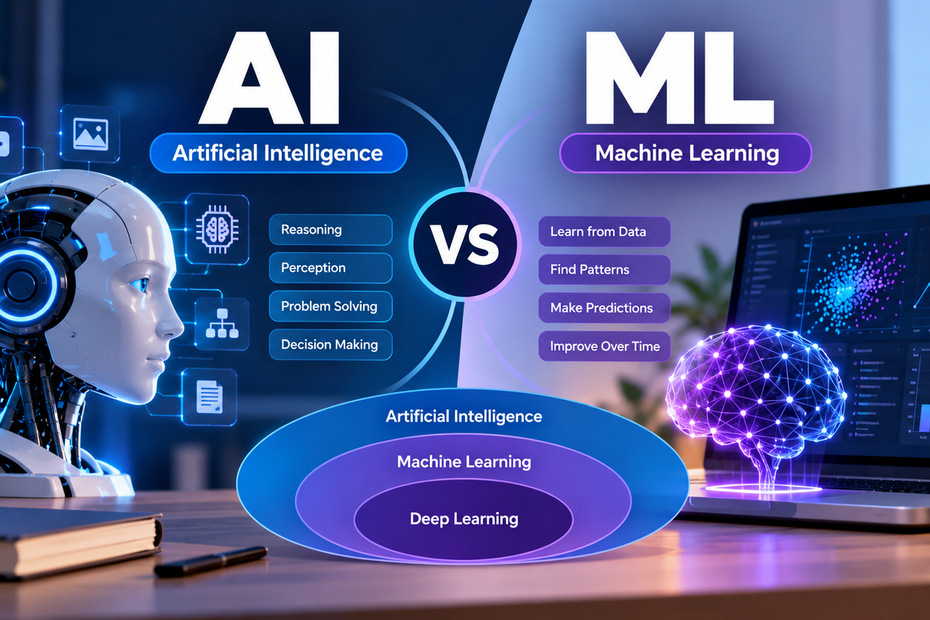
ML vs AI: Key Differences and Synergies Explained (2026). AI vs machine learning is not a competition between two separate technologies. Artificial intelligence is the broader field of building systems that perform tasks associated with intelligence, while machine learning is a major approach within AI that enables systems to learn patterns from data. They often work together to power predictions, recommendations, generative AI tools, and automation.
What Is Artificial Intelligence (AI)?
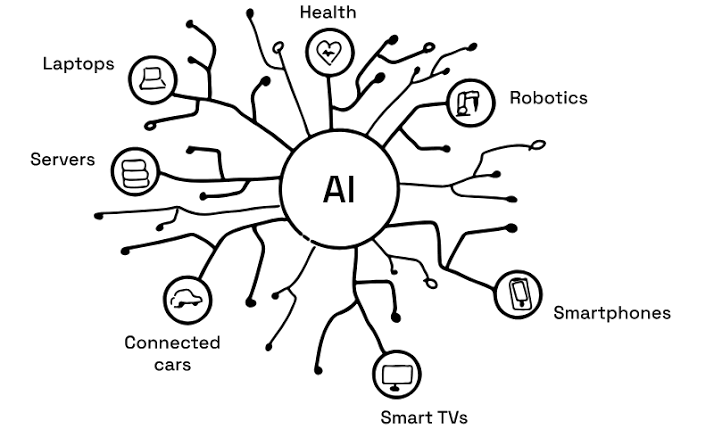
Artificial intelligence is a broad field of computer science focused on creating systems that can perform tasks requiring capabilities commonly associated with human intelligence. These tasks may include recognizing images, understanding language, solving problems, making recommendations, planning actions, and supporting decisions.
AI does not always require a system to learn from data. Some AI applications rely on predefined rules, logical reasoning, search algorithms, or expert knowledge. Others use machine learning models to adapt their behavior based on patterns found in data.
Examples of artificial intelligence
- Virtual assistants: Answer questions, understand voice commands, and help users complete tasks.
- Fraud detection systems: Flag suspicious financial transactions for further review.
- Robotics: Combine perception, planning, and control to perform physical tasks.
- AI-powered customer support: Help users find information and resolve common problems.
- Planning systems: Evaluate possible actions and select a suitable sequence to achieve a goal.
AI is an umbrella term, not a single tool or algorithm. The approach used depends on the task, the available information, and the level of autonomy required.
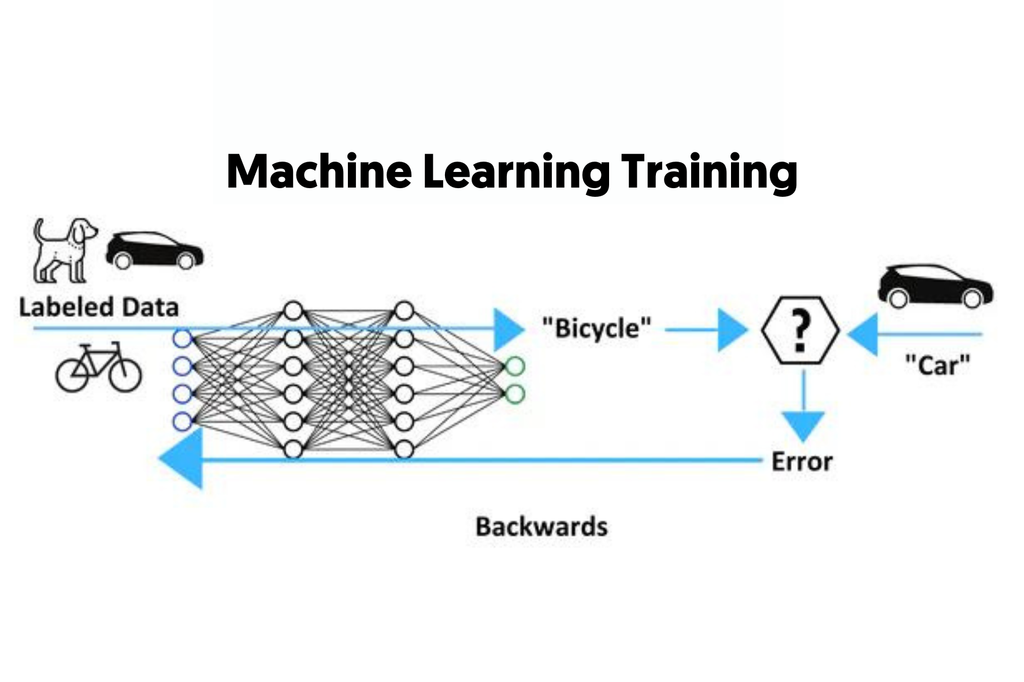
Machine learning is a subset of AI that enables computer systems to learn patterns from data and use those patterns to make predictions, classify information, or support decisions.
Rather than manually writing a separate rule for every possible situation, developers train an ML model using relevant examples. The model learns statistical relationships that can be applied to new data.
For example, a bank can train a machine learning model on historical transactions to identify patterns associated with potentially fraudulent activity. When a new transaction arrives, the model estimates whether it resembles suspicious transactions seen during training.
The model does not automatically know the truth. Its results depend on data quality, model design, evaluation, and the conditions in which it is used.
Main types of machine learning
1. Supervised learning
The model learns from examples that include known answers or labels. It is commonly used for spam detection, price prediction, and classifying transactions.
2. Unsupervised learning
The model looks for patterns or groups in data without relying on predefined target labels. Businesses may use it to segment customers or explore unusual behavior.
3. Reinforcement learning
An agent learns to choose actions through interaction with an environment and feedback in the form of rewards or penalties. It can be useful in robotics, control systems, and selected decision-making tasks.
These approaches serve different purposes, and the right choice depends on the problem being solved.
AI vs Machine Learning: Key Differences
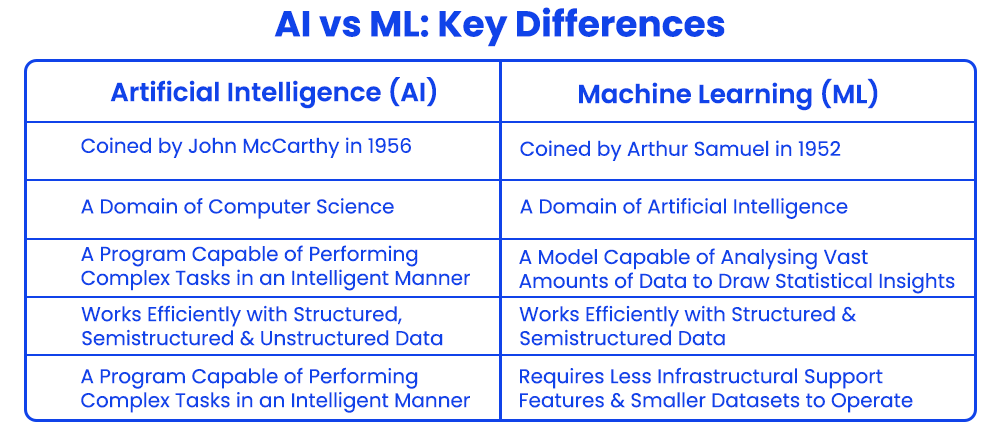
The main difference is scope. AI describes the broader goal of building intelligent systems, while ML describes a family of methods that learn patterns from data.
| Feature | Artificial Intelligence | Machine Learning |
|---|---|---|
| Meaning | Broad field of intelligent systems | Subset of AI focused on learning from data |
| Main goal | Perform tasks involving reasoning, perception, planning, or decisions | Learn patterns to make predictions or decisions |
| Common methods | Rules, search, planning, logic, ML, and more | Statistical models, decision trees, neural networks, and other learning algorithms |
| Data requirements | Depends on the approach | Usually requires suitable training or interaction data |
| Adaptability | Depends on system design | Models can generalize from training data and may be retrained or updated |
| Typical examples | Rule-based expert systems, planning software, AI assistants | Spam classifiers, recommendation models, demand forecasting |
| Evaluation | Depends on the system’s purpose | Often measured with task-specific model metrics and real-world performance |
One important point: AI and ML are not interchangeable terms. A system can use AI techniques without machine learning, and an ML model is considered an AI technique.
A simple everyday example
Imagine an online store that recommends products to customers.
A basic rule-based system might recommend winter coats to users who select a winter clothing category. Its behavior follows predefined instructions.
A machine learning model could analyze past purchases, product interactions, browsing patterns, and other relevant signals to estimate which products a customer may prefer.
A broader AI-powered recommendation system might combine ML predictions with business rules, product availability, user preferences, and a recommendation interface to decide what to show.
In this example, ML provides a way to learn from data, while the overall AI application combines multiple components to achieve a wider goal.
How Deep Learning Fits Into ML vs AI
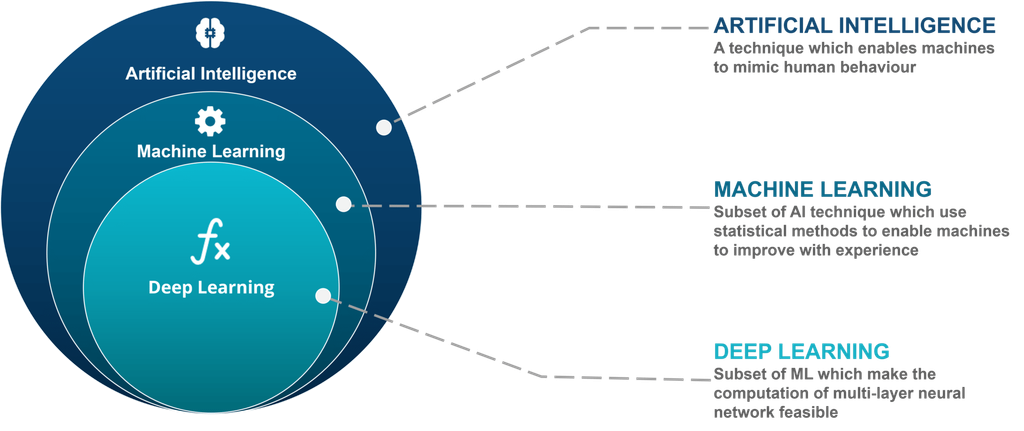
Deep learning is a specialized subset of machine learning that uses neural networks with multiple layers to learn complex patterns.
These networks can process information such as text, images, audio, video, and numerical data. Deep learning has played a major role in advances in speech recognition, computer vision, language models, and generative AI.
The relationship can be summarized as follows:
- Artificial intelligence: The broad field.
- Machine learning: A subset of AI that learns patterns from data.
- Deep learning: A subset of ML based on multilayer neural networks.
- Generative AI: AI systems designed to generate new content, such as text, images, audio, or code. Many modern generative systems use deep learning.
Not every AI system uses ML, and not every ML system uses deep learning. Traditional models such as linear regression and decision trees remain useful for many business problems.
How AI and ML Work Together
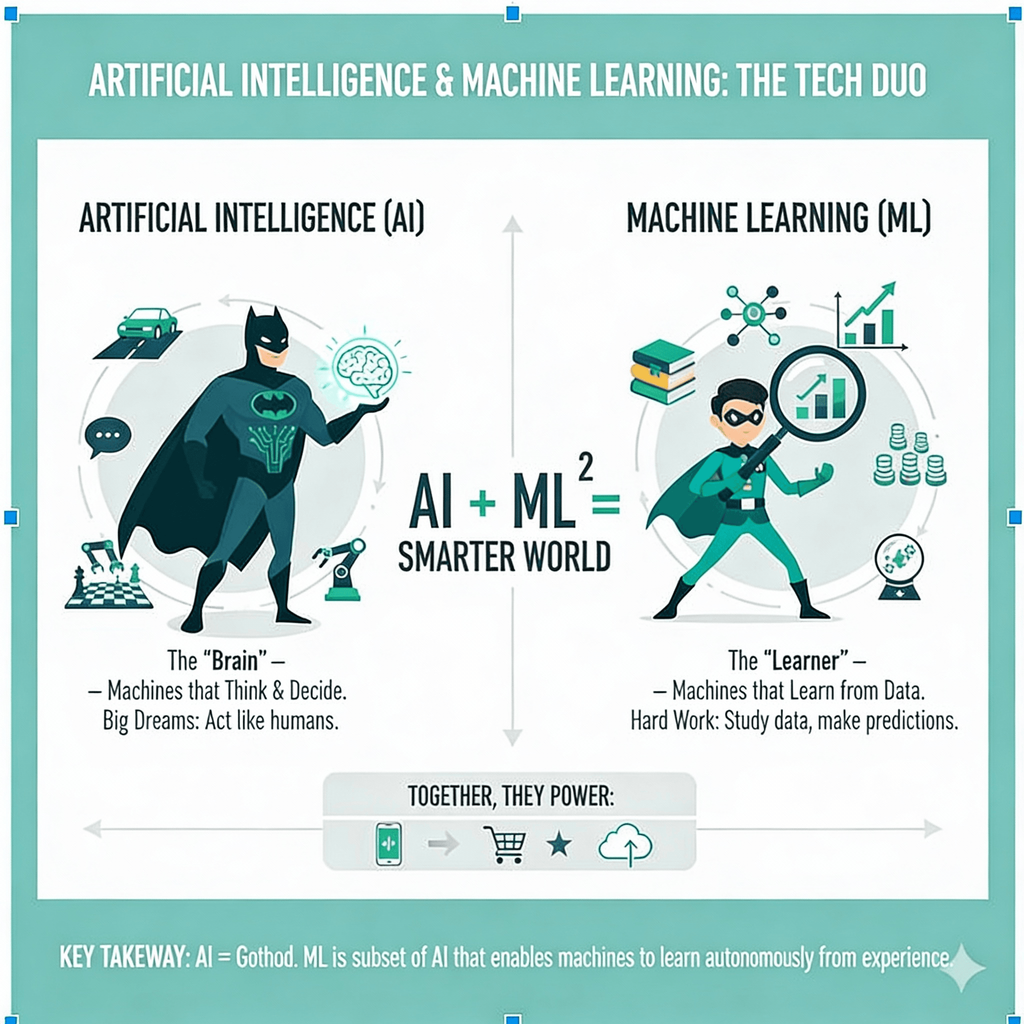
AI and ML are often most useful when combined. Machine learning models can recognize patterns or produce predictions, while the wider AI application uses those outputs to support a task or workflow.
A typical process may look like this:
- Define the problem: Decide what the system needs to predict, recognize, generate, or accomplish.
- Collect and prepare information: Gather relevant data, check its quality, and address privacy and access requirements.
- Train or select a model: Choose an appropriate ML model or an existing AI model for the task.
- Evaluate performance: Test the model on suitable data and check for errors, bias, and limitations.
- Integrate the model: Connect its output to an application, workflow, or decision-support system.
- Monitor results: Track performance in real-world use and update the system when necessary.
Consider a retailer trying to reduce product shortages. An ML model may forecast demand using historical sales and seasonal patterns. A wider AI-enabled workflow can combine that forecast with inventory rules, supplier lead times, and purchasing limits to help staff plan replenishment.
The model’s forecast is only one part of the solution. The overall system must also account for changing conditions and business constraints.
Real-World Applications of AI and ML
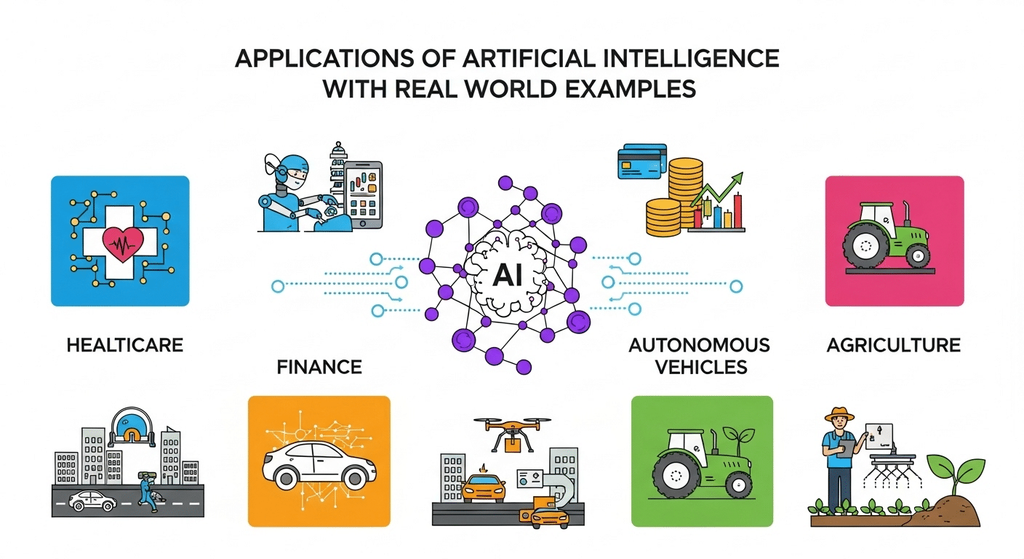
AI and ML appear across industries, although their exact roles vary by application.
1. Healthcare
Machine learning models can analyze medical images, identify patterns in patient data, or estimate health risks. Broader AI systems can help organize information and support clinical workflows.
These applications require careful validation, privacy protections, and appropriate professional oversight. Model outputs should not automatically replace qualified medical judgment.
2. Finance and banking
Banks use ML for fraud detection, credit-risk analysis, and transaction monitoring. AI systems can combine model results with business rules and investigation workflows.
A flagged transaction is not necessarily fraudulent. Financial institutions need processes to review uncertain results and reduce unfair or inaccurate decisions.
3. E-commerce and retail
Recommendation engines use customer and product signals to estimate what shoppers may want. ML can also support demand forecasting, inventory planning, and customer segmentation.
AI applications may combine these predictions with product availability, user preferences, and business policies to personalize shopping experiences.
4. Cybersecurity
ML models can help detect unusual network activity, suspicious login patterns, and potentially harmful files. AI systems can combine alerts and context to help security teams prioritize investigations.
Attackers also adapt their methods, so security systems require ongoing evaluation and human review.
5. Transportation and logistics
ML can help forecast traffic, estimate delivery times, and predict equipment failures. AI-based planning systems can use these estimates to compare routes or schedule operations.
Actual performance depends on the reliability of data, changing conditions, and the constraints built into the system.
6. Education
AI tools can help learners practice skills, receive explanations, or organize study material. ML can support recommendations based on learner activity and progress.
Educational institutions should consider accuracy, privacy, accessibility, and the importance of independent learning.
Generative AI and Agentic AI in 2026
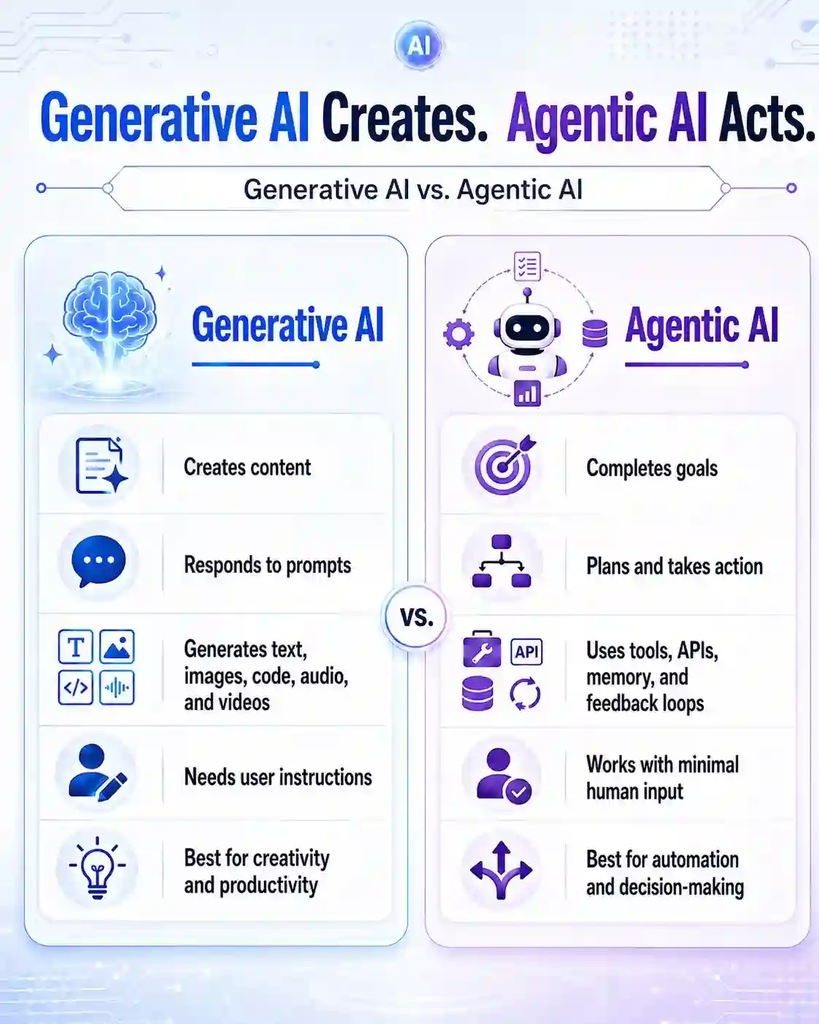
Generative AI has made the relationship between AI and ML more visible. Tools that generate text, images, audio, and code often rely on large models trained with machine learning techniques, especially deep learning.
For example, a language model learns statistical patterns from training data and uses them to generate responses to prompts. The resulting output may sound confident while still containing errors, so important information should be verified.
What is multimodal AI?
Multimodal AI works with more than one type of information, such as text and images, or audio and video. Machine learning models help process and connect these different inputs.
A practical example is a system that accepts a written question and an image, then produces an answer that considers both.
What is agentic AI?
Agentic AI refers to systems designed to pursue a goal through multiple steps, sometimes using tools, memory, planning, or feedback. Depending on the architecture, such systems may use one or more ML-based models alongside software rules and external tools.
For example, an AI workflow might summarize customer feedback, categorize recurring issues, and prepare a report for a team member to review.
However, agentic systems are not automatically reliable or fully autonomous. They can make mistakes, misinterpret instructions, or take inappropriate actions if safeguards are weak. Permission controls, testing, monitoring, and human approval for consequential actions remain important.
The key takeaway is that generative and agentic AI expand the kinds of tasks AI applications can attempt, while ML remains a major technology behind many of these capabilities.
Benefits and Limitations of AI and ML
Benefits
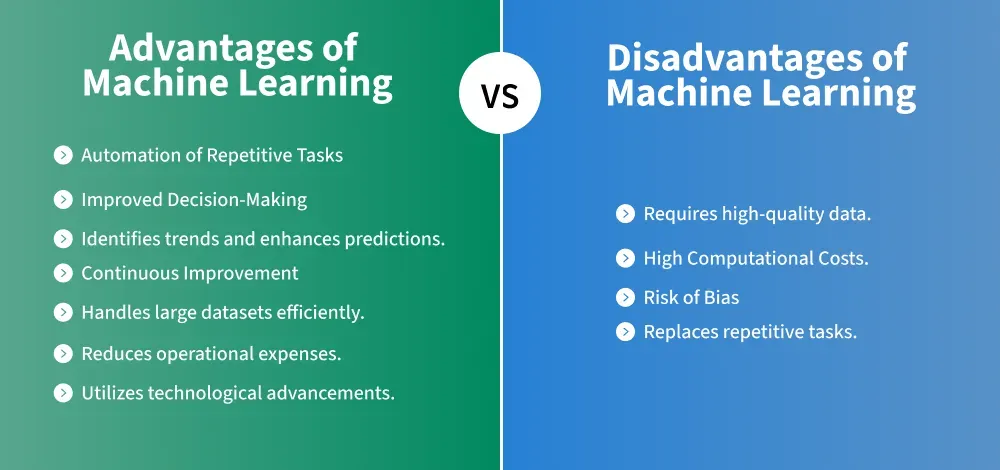
- Automation: Reduce repetitive work when a task is suitable for automation.
- Pattern discovery: Find relationships in datasets that may be difficult to spot manually.
- Prediction: Estimate outcomes such as demand, risk, or equipment failure.
- Personalization: Tailor recommendations and experiences to user needs.
- Decision support: Combine predictions and information to help people make informed choices.
- Scalability: Process large amounts of information when the infrastructure and system design support it.
Limitations
- Data quality: Incomplete, outdated, or biased data can lead to poor results.
- Uncertainty: Predictions and generated answers can be wrong.
- Cost and complexity: Training, deployment, computing resources, and maintenance can require significant investment.
- Privacy and security: Sensitive information needs appropriate protection and access controls.
- Bias and fairness: Models may produce uneven outcomes across different groups.
- Explainability: Some complex models are difficult to interpret.
- Monitoring needs: Performance can change as data and real-world conditions evolve.
AI and ML should be selected because they address a real problem—not simply because they are popular technologies.
How to Choose Between AI and ML for a Project
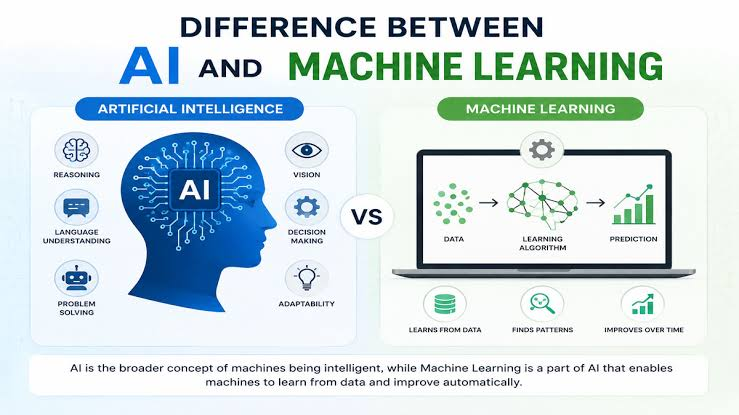
For many projects, the decision is not strictly AI versus ML. Instead, determine whether the problem needs a rule-based solution, a model that learns from data, a generative model, or a combination of approaches.
Use these questions to guide the decision:
- Can simple rules solve the problem? If the logic is stable and straightforward, a rule-based system may be easier to build and maintain.
- Do you need to learn patterns from examples? ML may be suitable for classification, prediction, ranking, or recommendations.
- Do you need to generate content? A generative AI model may help with text, images, audio, or code, depending on the task.
- Does the workflow require multiple steps or tools? A broader AI application may coordinate models, software tools, and rules.
- Can you evaluate the result? Define measurable success criteria and test the solution before deploying it.
- What are the risks? Consider privacy, security, fairness, cost, and whether a human must approve important decisions.
Start with the simplest approach that meets the requirements. More complex AI systems are not automatically better.
Skills and Career Opportunities in AI and Machine Learning
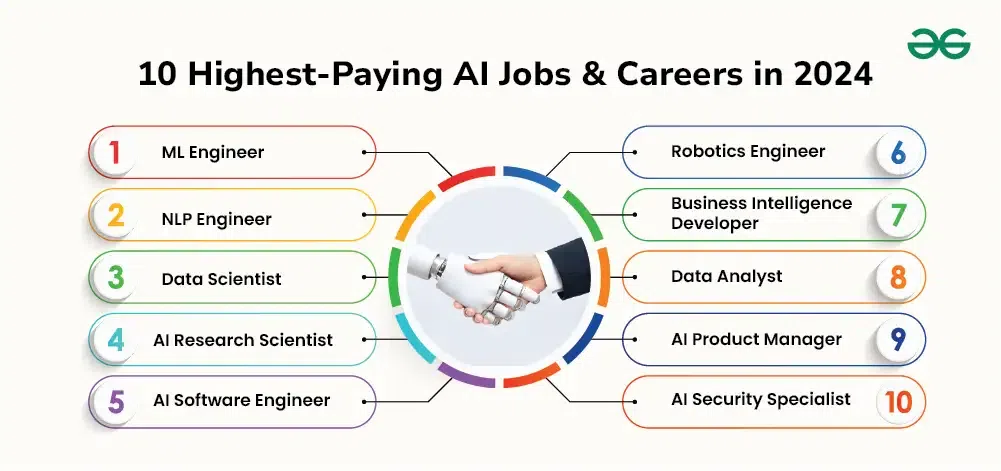
AI and ML offer different learning paths, but they share several foundations. Beginners do not need to master every field at once; the best starting point depends on their interests and goals.
Useful skills for AI and ML
- Python programming: Widely used for data analysis, model development, and AI applications.
- Mathematics and statistics: Helpful for understanding model behavior, uncertainty, and evaluation.
- Data preparation: Learn how to clean, organize, and validate datasets.
- Machine learning fundamentals: Study training, testing, overfitting, evaluation metrics, and model selection.
- Deep learning: Explore neural networks when your goals require them.
- Software engineering: Learn APIs, version control, testing, and deployment.
- Responsible AI: Understand privacy, fairness, security, and limitations.
Career paths to explore
| Role | Typical focus |
|---|---|
| Data Analyst | Analyze data and communicate insights |
| Data Scientist | Explore data, build statistical models, and solve analytical problems |
| Machine Learning Engineer | Build, deploy, and maintain ML systems |
| AI Engineer | Integrate AI models and tools into applications |
| Research Scientist | Develop or investigate new AI and ML methods |
| MLOps Engineer | Support reliable deployment, monitoring, and management of ML models |
These roles can overlap, and actual responsibilities vary by employer.
A practical beginner roadmap
- Learn Python and basic statistics.
- Practice data analysis using real datasets.
- Build a small supervised learning project, such as classifying spam or predicting a measurable outcome.
- Learn how to evaluate models and explain their limitations.
- Create a portfolio that documents the problem, data, method, results, and lessons learned.
- Explore deep learning or generative AI after establishing the fundamentals.
Projects that demonstrate careful thinking and reliable evaluation are more valuable than simply listing many tools on a résumé.
Frequently Asked Questions
1. Is machine learning the same as artificial intelligence?
No. Artificial intelligence is the broader field, while machine learning is a subset of AI that learns patterns from data. Many AI applications use ML, but AI can also use rules, logic, search, and planning without machine learning.
2. Which is better, AI or machine learning?
Neither is universally better. AI describes a broad field, while ML is one approach within it. The right choice depends on whether the task needs predefined rules, learning from data, content generation, or a combination of capabilities.
3. Can AI work without machine learning?
Yes. Rule-based systems, search algorithms, and logic-based expert systems can perform certain AI tasks without learning from data. Machine learning is a major part of modern AI, but it is not the only approach.
4. Is deep learning a type of AI or ML?
Deep learning is a subset of machine learning, which itself is a subset of AI. It uses neural networks with multiple layers to learn complex patterns from data.
5. Does generative AI use machine learning?
Many modern generative AI systems use machine learning, particularly deep learning. Large language models and image-generation models learn patterns from training data to produce new outputs. Their results can still be inaccurate and need appropriate evaluation.
6. What is the difference between AI, ML, and data science?
AI focuses on systems that perform intelligent tasks. ML focuses on learning patterns from data. Data science is a broader discipline that uses statistics, programming, domain knowledge, and analytical methods to extract insights and solve problems. The three fields overlap but are not identical.
7. Is machine learning difficult to learn?
It can be challenging because it combines programming, data preparation, statistics, and model evaluation. Beginners can make progress by learning Python, practicing basic data analysis, and building small projects before moving to advanced algorithms.
8. What are the risks of AI and machine learning?
Risks include inaccurate outputs, biased decisions, privacy violations, security vulnerabilities, and difficulty explaining some model predictions. Responsible development requires testing, monitoring, safeguards, and human oversight appropriate to the use case.
9. Will AI replace machine learning?
AI is not a replacement for machine learning because ML is one of the approaches used to build many AI systems. New methods may change how models are trained or deployed, but the concepts of learning from data and building intelligent applications remain distinct and complementary.
Conclusion
The difference between AI and machine learning becomes clearer when you look at their roles. AI is the broader field of building systems that perform intelligent tasks, while ML enables systems to learn useful patterns from data. Deep learning extends ML with multilayer neural networks, and many modern generative AI applications rely on these techniques.
In 2026, understanding how these technologies work together is more useful than treating them as competing trends. Whether you are exploring a career, planning a product, or learning about emerging technology, begin with the problem you want to solve, choose an appropriate approach, and evaluate the results carefully.
The future of AI will depend not only on more capable models, but also on reliable data, responsible design, and people who know how to apply these technologies thoughtfully.